Last updated 2026-08-14
TL;DR
Searching "mosquito pest control near me" usually means comparing barrier sprays, misting systems, and DIY source reduction. Barrier treatments (applied every 10-14 days) knock populations down 70-90% for 1-3 weeks; misting systems automate that but cost more upfront. Nothing eliminates mosquitoes; combine a professional plan with dumping standing water weekly for the best results.
How do I get rid of mosquitoes in my yard?
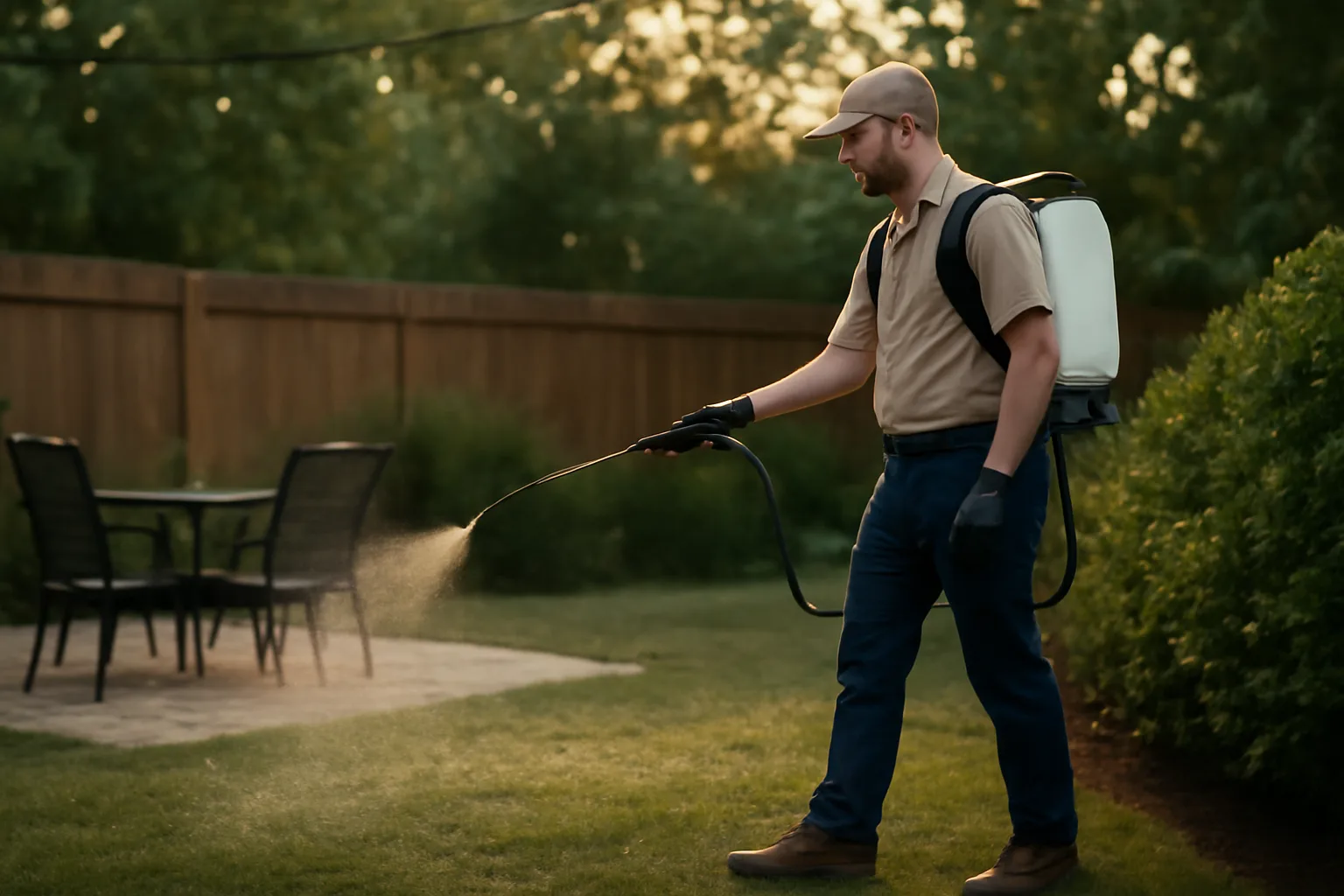
You get rid of most of your yard's mosquitoes by combining two things: killing the adults that are already there and removing the water where new ones are breeding. Neither alone works well for long. A barrier spray with no source reduction just gets overwhelmed by mosquitoes hatching from your own gutters and plant saucers. Source reduction with no barrier spray still leaves you exposed to mosquitoes flying in from a neighbor's yard, a nearby creek, or a storm drain. Professional barrier treatments use an EPA-registered pyrethroid or a plant-derived pesticide sprayed on vegetation, fence lines, and other resting surfaces where adult mosquitoes hide during the day. Applied correctly, per label instructions, these treatments reduce mosquito populations noticeably within a day and keep working for roughly 10 to 21 days depending on the product and weather. That's why most services, including ours, run on a 10-14 day cycle rather than a one-time spray. Rain, heat, and new growth all shorten how long a treatment lasts. On the DIY side, the CDC and most state extension services agree the single highest-value habit is dumping or treating standing water once a week, because that's how long it takes many mosquito species to go from egg to biting adult [1]. Check anything that holds even an inch of water: clogged gutters, plant saucers, kiddie pools, tarps, old tires, and birdbaths. A capful of standing water in a bottle cap can produce dozens of mosquitoes. If you want a professional plan built around your specific yard rather than guessing at product and schedule, a free yard assessment from a local service will map out where mosquitoes are breeding and resting before recommending barrier spray or a misting system.
How do I keep mosquitoes away long-term, more than kill the ones I have?
Keeping mosquitoes away long-term means treating your yard on a schedule, not a one-time event, because adult mosquitoes you kill today get replaced by new ones hatching next week. That's the whole logic behind the 10-14 day barrier cycle: it's timed to the gap between treatments wearing off and the next generation emerging. Beyond spraying, four habits matter more than people expect. First, fix screens on windows and doors; a single tear the width of a pencil is enough for mosquitoes to get through. Second, run box fans or ceiling fans on your patio; mosquitoes are weak fliers and most species struggle in wind above roughly 1-2 mph, according to entomology research on their flight capability. Third, keep grass and shrubs trimmed, since adult mosquitoes rest in shade during the heat of the day and tall vegetation gives them cover. Fourth, treat or empty water sources weekly, all season, more than once in spring. Misting systems automate the barrier-spray part of this. They're plumbed nozzles installed around the yard's perimeter that release a fine mist of insecticide on a timer, typically once or twice a day at dawn and dusk when mosquitoes are most active. Installed systems commonly run somewhere in the $2,000 to $6,000+ range depending on yard size and nozzle count, according to home services cost data, plus a refill or service contract [2]. They're more convenient than remembering to schedule a technician visit, but they use more pesticide over a season than a targeted 10-14 day barrier spray, which only some homeowners are comfortable with. If you're deciding between the two, a mosquito control comparison can walk through the tradeoffs in more depth.
How do I get rid of ticks in my yard?
Tick control in a yard works on a different principle than mosquito control: ticks don't fly in from breeding water, they arrive on deer, rodents, birds, and pets, then sit in leaf litter and tall grass waiting for a host to brush past. That means the fix is about denying them habitat and host access, not draining standing water. The CDC and university extension guidance both point to the same core yard changes: keep grass mowed short, clear leaf litter and brush, and create a 3-foot-wide barrier of wood chips or gravel between your lawn and any woods or stone walls, since ticks rarely cross a dry, open strip like that [3]. Stack woodpiles neatly and in dry, sunny spots to discourage the rodents ticks feed on. Keep playground equipment and patios away from yard edges and in sunny spots, since ticks dry out and die in direct sun and low humidity. Chemical tick control usually means a granular or liquid acaricide applied to the yard perimeter, leaf litter zones, and stone walls, often on a spring-through-fall schedule timed to nymph and adult tick activity. The EPA notes that professional or homeowner-applied yard treatments, when applied per label, can reduce tick populations, though they work best layered onto the habitat changes above rather than as a replacement for them [4]. For pets and people, a separate tick repellent applied to skin, clothing, or gear handles the ticks that do make it onto a host, which yard treatment alone can't fully prevent.
How do you get rid of ticks from your yard specifically (more than the woods nearby)?
Getting ticks out of your actual yard, as opposed to the tree line beyond it, starts with mapping where they concentrate. Ticks cluster in shaded, humid edges: the strip where lawn meets woods, under shrubs, along stone walls, and in tall grass near fences. Very few ticks are found in the open, sunny middle of a mowed lawn. A practical yard-by-yard plan looks like this: mow regularly and keep grass under 3 inches, rake out leaf litter every fall, trim back shrubs and ground cover along the property edge, and install that 3-foot wood-chip or gravel barrier extension mentioned above wherever lawn meets woods or a stone wall [3]. Discourage deer with fencing or deer-resistant plantings, since white-tailed deer are a major host for adult ticks and reducing deer traffic through a yard measurably reduces tick numbers over time. For active treatment, targeted acaricide sprays applied to those edge habitats (not the whole lawn) hit ticks where they actually live, which is more efficient than blanket-spraying grass they mostly avoid. Some services combine this with a broader mosquito barrier visit, since the same 10-14 day or seasonal schedule and the same resting-surface logic (shrubs, fence lines, shaded edges) applies to both pests. If deer, rodents, or a wooded property line are driving repeat tick problems, that's worth mentioning during a free yard assessment so the plan accounts for the actual habitat, more than a generic perimeter spray.
What plants repel mosquitoes, and does planting them actually work?
Several common plants contain compounds that repel mosquitoes in lab or extracted-oil form, but planting them in your yard is not the same as applying a repellent, and the effect on live plants is modest at best. Citronella grass, lemon balm, catnip, marigolds, lavender, basil, and rosemary all get cited as mosquito repellent plants, largely because their essential oils (citronellal, nepetalactone, linalool) show repellent activity when extracted and concentrated [5]. The catch is concentration and delivery. A 2001 study published in the Journal of the American Mosquito Control Association found that oil extracted from catnip (nepetalactone) repelled mosquitoes roughly as well as, or better than, DEET at similar concentrations in lab testing [6]. That's a real result, but it's about the extracted oil, not a live catnip plant sitting in a pot on your patio, which releases far less of the compound into the air than a crushed-leaf extract or an applied oil. So the honest answer: growing these plants around a patio might contribute a small, hard-to-measure reduction in mosquitoes nearby, and they're genuinely nice to have (herbs are useful, marigolds look good, lavender smells great). But no extension service or entomology department recommends relying on planted mosquito repellent plants as your main defense. Use them as a pleasant supplement to barrier treatment and source reduction, not a replacement for either. If you want a repellent with actual field-tested efficacy for skin or clothing, look at natural mosquito repellent options with published effectiveness data instead.
How do I get rid of mosquitoes in my house?
Mosquitoes in the house almost always mean two things: they're getting in through a gap, and/or they're breeding in water somewhere indoors or right outside a door. Fixing both stops the problem faster than any indoor spray alone. Start with entry points. Check window and door screens for tears or gaps around the frame; even a quarter-inch gap under a door is enough. Check that door sweeps seal fully and that any vents or dryer exits have intact screening. Mosquitoes are also drawn indoors by light and CO2, so an open door at dusk with the porch light on is basically an invitation. For breeding sources, check indoor plant saucers, vases with standing water, unused humidifiers, and any drain that holds water intermittently, since some mosquito species (like the ones that cause the most house complaints) can complete their life cycle in surprisingly small amounts of stagnant water indoors. Empty and dry these weekly. For mosquitoes already inside, a few tools work: a plug-in indoor insecticide or an EPA-registered aerosol labeled for flying insects (applied per label directions, in a ventilated room, away from food prep surfaces), a bug zapper (modestly effective at best; research shows they kill many more non-target insects than mosquitoes), or simply a fly swatter and patience for a small number. Mosquitoes tend to rest on walls and under furniture during the day, so check those spots rather than only chasing them mid-flight.
How do I get rid of mosquitoes in the house long-term, room by room?
Long-term indoor control is really about closing the gaps that let mosquitoes in and removing the small water sources that let them breed, room by room, rather than repeatedly treating symptoms. Entryways and windows: replace torn screens (a $5-15 fix per window with a screen repair kit), install or fix door sweeps, and consider a screen door for frequently-used patio doors. Basements and utility rooms: check floor drains, sump pump pits, and any dehumidifier reservoirs, since these often hold standing water unnoticed for weeks. Bathrooms and kitchens: don't let water sit in unused sink drains, buckets, or mop water overnight. Bedrooms: if mosquitoes are already getting through despite fixes, a bed net over sleeping areas is a low-cost, chemical-free backstop, especially useful in older homes or rentals where sealing every gap isn't practical. If the house sits next to standing water (a rain barrel, poor drainage, a low spot that pools after storms), no amount of indoor sealing fully solves it, because mosquitoes will keep pressuring every gap in the building envelope. In that case, outdoor source reduction and a yard barrier treatment do more for indoor mosquito counts than any indoor product will, since you're cutting off the source rather than intercepting mosquitoes one at a time after they've already gotten in.
How do I get rid of mosquitoes in my backyard specifically?
Backyard mosquito control comes down to three moves done consistently: eliminate standing water, treat resting surfaces, and reduce harborage. Skipping any one of them means the other two are working against a population that keeps refilling itself. Standing water first, because it's free and it's the highest-leverage move available. Walk the yard weekly and dump anything holding water: gutters, tarps, unused planters, kiddie pool covers, low spots in the lawn after rain, and the trays under potted plants. The CDC recommends this roughly weekly, matching the timeline for eggs to become biting adults in many common species [1]. Second, treat resting surfaces. Adult mosquitoes spend most of the day resting on the undersides of leaves, in shrubs, under decks, and along shaded fence lines, not flying around in open sun. That's exactly what barrier sprays target: an EPA-registered pesticide applied to vegetation and shaded structures, not a broad fog over the whole lawn. This is why professional barrier treatments (ours included) focus spray on the yard's edges and shade, not the open grass. Third, reduce harborage: thin dense shrubs, clear brush piles, and keep tall grass mowed, since dense vegetation both hides adult mosquitoes and holds humidity they need to survive daytime heat. Add a fan to the patio for immediate relief during use, since mosquitoes fly poorly in even light wind. None of this, alone or combined, eliminates mosquitoes completely; a realistic goal is a 70-90% reduction in biting pressure during peak activity, which is what well-timed barrier treatment studies and pest control industry data generally report.
When do mosquitoes go away for the season?
Mosquitoes typically become inactive once nighttime temperatures consistently drop into the 50s Fahrenheit, and most species stop flying and biting below about 50°F, though this varies by region and species, so your local extension service or health department is the most reliable source for your specific area. In much of the northern U.S., that means late October or November; in warmer southern and Gulf Coast states, mosquitoes can remain active nearly year-round, with only brief slowdowns in the coolest weeks. Mosquitoes don't actually die off entirely when it gets cold; many species overwinter as eggs (laid in a spot that will flood in spring) or as adult females that find a sheltered spot, like a crawl space, wood pile, or storm drain, and go dormant until temperatures rise again. That's part of why a single fall freeze doesn't permanently solve a mosquito problem; the population is paused, not gone, and it rebuilds from these overwintering eggs and adults once spring temperatures return. On the timing question in reverse: mosquito season typically starts once daytime temperatures reach the 50s to 60s consistently and there's been recent rain to create breeding water, which in much of the U.S. means April or May, though again this varies widely by region. If you're planning a seasonal barrier treatment schedule, starting the first application near that spring warm-up and running through the first hard fall frost covers the active season for most homeowners; a free yard assessment can pin down the right start and end dates for your specific climate.
Barrier spray vs. misting system: which should I actually get?
| Upfront cost | Low; typically a quote-based seasonal plan, no installation | Higher; commonly $2,000-6,000+ installed [2] | |
|---|---|---|---|
| Ongoing cost | Per-visit or seasonal plan pricing | Refill/service contract, often several hundred dollars per season | |
| How it's applied | Technician sprays vegetation and resting surfaces every 10-14 days | Automated nozzles mist on a timer, usually 1-2x daily | |
| Pesticide use over a season | Lower; targeted, less frequent | Higher; more frequent automated releases | |
| Effort required | Schedule and let technician in periodically | Minimal once installed, but system needs maintenance | |
| Best for | Most yards, renters, anyone unsure about long-term commitment | Larger properties, frequent outdoor entertaining, homeowners wanting hands-off automation | For most homeowners, a scheduled barrier treatment is the better starting point: lower cost, less pesticide applied across a season, and no plumbing installation. Misting systems make more sense for larger properties or households that entertain outside constantly and want mosquito control running without thinking about it, and are willing to trade some cost and pesticide volume for that convenience. Either way, treatments knock populations down for a window of time; neither one is a permanent fix, which is why the 10-14 day or automated-timer cycle exists in the first place. A mosquito control near me comparison can help if you're evaluating specific local providers. |
Both barrier sprays and misting systems reduce mosquito populations; they differ mainly in cost, convenience, and how much pesticide gets applied over a season. | Factor | Barrier spray (10-14 day cycle) | Installed misting system |
What should I ask a mosquito pest control company before hiring them?
A handful of questions separate a solid local provider from a company that's just going to fog your yard and disappear. Ask what specific EPA-registered product they use and whether it's a synthetic pyrethroid or a plant-derived option, since some homeowners with pets, bees, or ponds have real preferences here. Ask about the treatment cycle (10-14 days is standard for barrier sprays) and what happens after heavy rain, since rain can wash off a treatment early. Ask whether the technician does a habitat inspection (checking for standing water, resting sites, and yard-specific risk factors) or just sprays on a fixed schedule regardless of conditions; the inspection-based approach tends to perform better because it adapts to what's actually happening in your yard. Ask about pollinator precautions, since the EPA and most state pesticide regulations require label-compliant application timing to reduce risk to bees, meaning treatments are ideally applied when bees are less active and not directly on blooming flowers . Ask for the license number if your state requires pesticide applicator licensing, which most do, and confirm it's current with your state's department of agriculture. Finally, ask what results are realistic. Any company promising complete mosquito elimination is overselling; the honest claim is a significant reduction in biting mosquitoes for the length of the treatment cycle, not zero mosquitoes. A free yard assessment is a reasonable first step regardless of which provider you choose, since it costs nothing and gives you a specific plan to compare against other quotes.
Frequently asked questions
How do I get rid of mosquitoes fast for an outdoor event this weekend?
For a one-time event, rent or buy fans for the patio (mosquitoes fly poorly in wind), light citronella candles or torches as mild supplements, and ask a local pest control company if they offer a single pre-event barrier spray. Combine that with dumping any standing water nearby. None of this eliminates mosquitoes, but layered together it noticeably cuts biting pressure for a few hours.
How do I keep mosquitoes away without spraying chemicals?
Focus on source reduction (dump standing water weekly), physical barriers (repair screens, use bed nets), and airflow (a box fan on the patio, since mosquitoes struggle in wind above roughly 1-2 mph). Mosquito repellent plants like citronella and lemon balm offer a small supplemental benefit but aren't a replacement for these steps, according to entomology research on plant-based repellents [7].
How do I get rid of ticks on my dog or in my house?
For pets, use a veterinarian-recommended tick preventive (topical, oral, or collar) and check them after outdoor time, especially around ears and paws. In the house, vacuum frequently, since ticks that fall off a pet often end up in carpet or upholstery. Yard-level tick reduction (mowing, leaf litter removal, edge barriers) lowers how many ticks pets bring inside in the first place.
What plants repel mosquitoes the best?
Citronella grass, lemon balm, catnip, marigolds, lavender, basil, and rosemary all contain compounds with lab-tested repellent activity. A 2001 study in the Journal of the American Mosquito Control Association found catnip oil (nepetalactone) repelled mosquitoes comparably to DEET in testing [8]. Live plants release far less of these compounds than extracted oils, so treat them as a mild supplement, not a primary defense.
How do I get rid of mosquitoes in my house overnight?
Close windows and doors, seal any visible screen gaps, and check for indoor standing water (plant saucers, unused humidifiers, vases). Use an EPA-registered indoor aerosol labeled for flying insects, applied per label in a ventilated room, or a bed net over the sleeping area as a chemical-free backup. A plug-in device can help but won't clear mosquitoes already inside a room by itself.
When do mosquitoes go away for the year?
Most mosquito species become inactive once nighttime temperatures consistently drop into the 50s Fahrenheit, which means late fall in much of the U.S., though warm southern regions see year-round activity. Mosquitoes don't die off completely; many overwinter as eggs or dormant adults and return once spring temperatures rise. Check your local extension service for typical dates in your specific region [9].
How do I get rid of mosquitoes in my backyard permanently?
There's no permanent fix; mosquitoes are a renewable population fed by breeding water and mobile adults flying in from nearby areas. The realistic approach is ongoing management: weekly standing-water removal, a barrier treatment every 10-14 days during active season, and yard maintenance to reduce resting habitat. Done consistently, this keeps biting pressure low all season rather than eliminating mosquitoes outright.
How do you get rid of ticks from your yard without chemicals?
Mow grass short, remove leaf litter and brush, and create a 3-foot-wide wood-chip or gravel barrier between lawn and woods or stone walls, since ticks rarely cross a dry, open strip like that, per CDC and extension guidance [5]. Discourage deer with fencing, and keep play areas and patios in sunny, open spots away from yard edges, since ticks dry out and die in direct sunlight.
Is a mosquito misting system worth the cost compared to barrier spray?
Misting systems cost roughly $2,000-6,000+ installed plus ongoing refill costs, versus a lower-cost seasonal barrier plan with no installation. Systems are more convenient (automated timer, no scheduling) and better suited to large properties or heavy outdoor use, but they apply pesticide more frequently over a season. Most homeowners get equal or better results starting with scheduled barrier treatment first.
How often should mosquito barrier treatments be applied?
Most professional barrier treatments run on a 10-14 day cycle during active mosquito season, since that's roughly how long the EPA-registered products used typically remain effective on treated vegetation before wearing off from weather and new plant growth. Heavy rain can shorten that window, requiring an earlier re-treatment. Ask any provider what their specific cycle and rain policy is before signing on.
Can mosquitoes breed indoors, or do they always come from outside?
Mosquitoes can complete a full life cycle indoors if there's standing water available, such as an unused humidifier reservoir, a neglected vase, or a floor drain that holds water. It's less common than outdoor breeding, but if mosquitoes keep appearing indoors despite sealed entry points, check every water source in the house, more than the obvious ones, before assuming they're all coming from outside.
What's the difference between mosquito control and tick control in the same yard?
Mosquito control targets standing water (breeding source) and shaded vegetation (adult resting sites), since mosquitoes fly in and lay eggs anywhere wet. Tick control targets ground-level edge habitat (leaf litter, tall grass, stone walls) and host animals like deer and rodents, since ticks don't fly and instead wait in vegetation for a host to pass. Some providers combine both into one seasonal yard plan.
Sources
- CDC, Controlling Mosquitoes at Home: Standing water should be dumped roughly weekly to disrupt the mosquito breeding cycle
- Angi, Mosquito Misting System Cost Guide: Installed mosquito misting systems commonly cost in the $2,000-6,000+ range
- CDC, Preventing Ticks in the Yard: A wood-chip or gravel barrier between lawn and woods reduces tick migration into yards
- Purdue University Extension, Plant-based Mosquito Repellents: Certain plants contain essential oil compounds with documented mosquito-repellent activity
- Journal of the American Mosquito Control Association, Bioassay of Catnip Oil (nepetalactone): Catnip oil (nepetalactone) showed repellent activity comparable to DEET in laboratory testing
- CDC, Mosquito Life Cycle and Seasonality: Mosquito activity and life cycle timing are strongly temperature dependent and vary regionally