Last updated 2026-08-14
TL;DR
Searching for mosquito control services near you? Most local companies offer a free yard assessment, then a barrier spray on a 10-14 day cycle (roughly 3-6 weeks in real-world knockdown per CDC guidance) or a misting system. No spray eliminates mosquitoes; it reduces the adult population between visits while you handle standing water yourself.
how do I find mosquito control services near me and what should I expect from the first visit
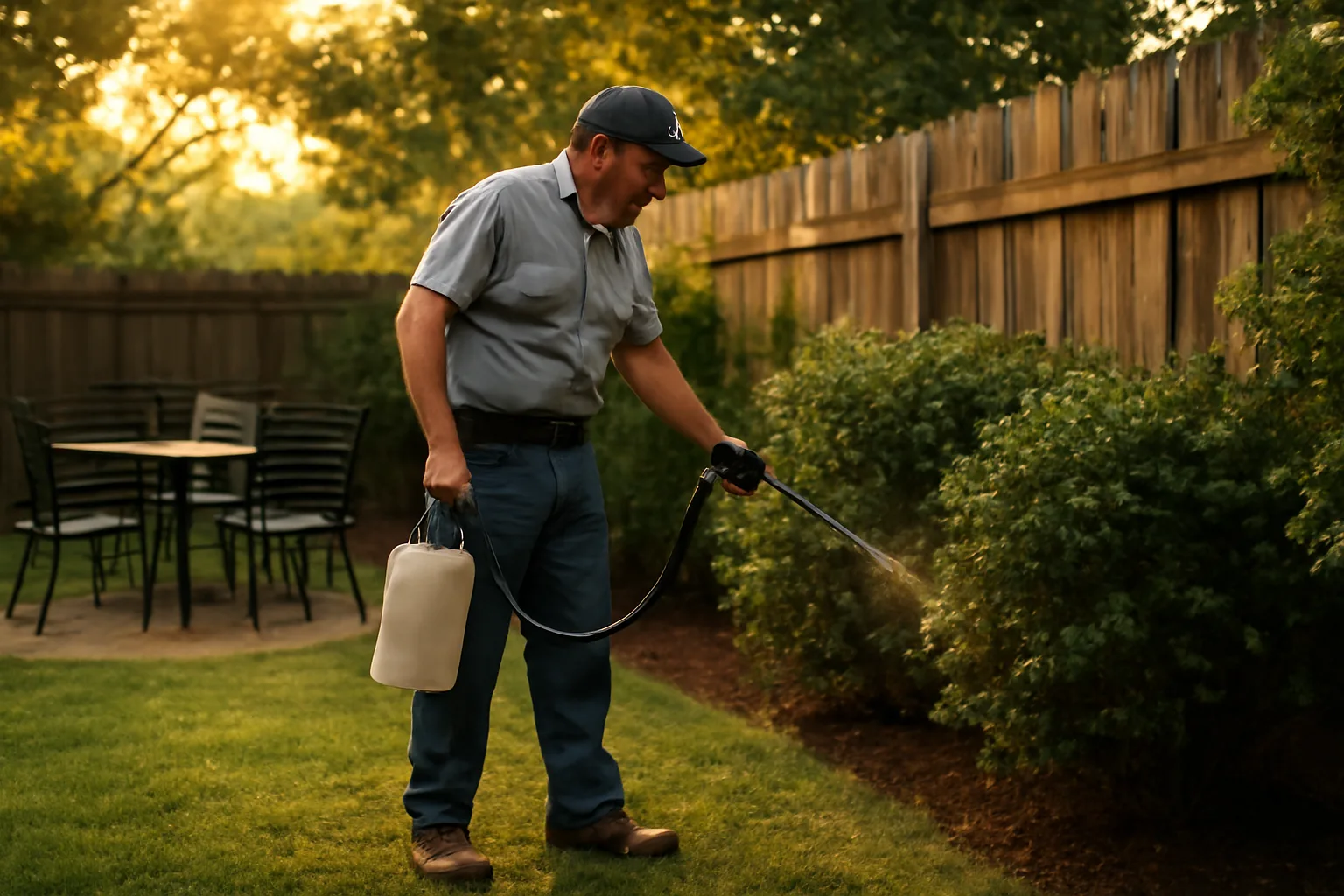
A legitimate local company starts with a free walk-through of your yard, not a phone quote. They're looking at shade, standing water, vegetation density, and where mosquitoes are resting during the day, usually the underside of leaves, dense shrubs, and shaded fence lines. That inspection is what a quote is actually based on, not square footage alone. Ask what license the technician is applying under. Most states require a commercial pesticide applicator license to spray for hire, issued through the state's department of agriculture or environmental agency. If a company can't name their license number when asked, that's a real red flag, not a technicality. After the walk-through, expect one of two proposals: a barrier spray on a recurring cycle (commonly every 10 to 14 days during the season) or an automated misting system installed around the yard's perimeter. Both approaches target adult mosquitoes resting in vegetation. Neither one is a one-time fix; mosquito populations rebuild from eggs, nearby standing water, and adults flying in from neighboring properties, so the value is in the schedule, not a single treatment. If you want a full walkthrough of what these barrier and misting programs involve before you call anyone, mosquito control breaks down both methods in more depth. For a first-time appointment, Get a free yard assessment is the actual first step, not a generic spray booking.
how to get rid of mosquitoes in your yard for good
You can't get rid of mosquitoes 'for good' in any yard that borders trees, ditches, or a neighborhood with any standing water at all. What you can realistically do is knock the population down hard and keep it down through the season. That takes two things working together: source reduction (removing water they breed in) and a recurring barrier treatment (killing adults resting in your vegetation). The CDC is direct about the water part: "Mosquitoes need water to breed. Getting rid of items that hold water helps reduce the number of mosquitoes around your home" [1]. A female mosquito needs as little as a bottle cap of standing water to lay eggs, and many species complete an egg-to-adult cycle in about 7 to 10 days depending on temperature [1][2]. That means a forgotten saucer under a potted plant can be producing new adults every week and a half all summer. Walk your property every 3 to 4 days during mosquito season and dump, drill, or remove anything holding water: clogged gutters, tarps, unused kiddie pools, tire swings, plant saucers, and low spots in the yard that pool after rain. Birdbaths need dumping and refilling twice a week. If you have a rain barrel, screen the top. On top of source reduction, a barrier spray applied to vegetation, fence lines, and shaded resting spots typically knocks down the resting adult population for roughly 2 to 3 weeks before it needs reapplying, which is why most services run on a 10 to 14 day cycle rather than a monthly one. EPA-registered products used for this are applied strictly per label instructions; no company should ever describe a yard spray as "safe" or "non-toxic" outright, only as registered and applied according to label directions [3].
how to keep mosquitoes away from your patio and evenings outside
For the evenings you actually want to sit outside, layering matters more than any single product. A ceiling fan or box fan on the patio does real work here: mosquitoes are weak fliers and struggle in even light, moving air, which is why porches with fans tend to have noticeably fewer mosquitoes landing on people [1]. Personal repellents remain the most consistent short-term defense. The EPA and CDC both point to products containing DEET, picaridin, IR3535, oil of lemon eucalyptus (OLE), 2-undecanone, or para-menthane-diol as effective active ingredients, and the CDC states these "have been shown to provide long-lasting protection" when used as labeled [4]. Concentration matters more than brand: a 20% to 30% DEET product generally protects longer than a 5% one, though it also doesn't extend protection indefinitely past a certain point. Citronella candles and tiki torches give a small, localized reduction at best; they are not a substitute for repellent on skin or clothing if mosquitoes are heavy. Outdoor foggers used right before an event provide a few hours of knockdown, which is fine for a one-off party but not a season strategy. For the yard itself, a scheduled barrier treatment plus removing standing water is what actually keeps the baseline population low, so you're not relying on repellent alone every single evening. That's the difference between managing mosquitoes reactively and running a plan; see mosquito control near me if you're comparing local providers on cost and service structure.
how to get rid of mosquitoes in the house
Indoor mosquitoes almost always trace back to one of two things: an opening they got in through, or standing water inside the house they're breeding in. Check window screens for holes, gaps under doors, and any standing water in drain pans under refrigerators, basement floor drains, or even plant saucers kept indoors. For mosquitoes already inside, a flyswatter is genuinely one of the more effective tools for a small number of them; there's no product that clears a room instantly and safely. Plug-in devices using EPA-registered active ingredients like prallethrin or transfluthrin can help in enclosed spaces, but they're meant for temporary knockdown, not a permanent indoor solution, and should be used exactly per label directions, not left running continuously without following the product's specified use pattern. The better long-term fix is stopping entry. Repair torn screens, add door sweeps, and check that window AC units are sealed around the edges. If mosquitoes keep appearing indoors despite sealed entry points, that usually points to an outdoor breeding source close to the house, like a clogged gutter section right outside a window, and the fix is outside, not inside.
when do mosquitoes go away and does timing affect treatment
Mosquito activity generally drops once nightly temperatures fall consistently below about 50°F, since most common mosquito species become inactive and stop flying at that threshold [5]. In much of the northern U.S. that's late September through October; in the Gulf Coast and much of the Southeast, mosquitoes can stay active nearly year-round because temperatures rarely stay cold enough long enough to fully knock the population down [5]. This is regional and worth confirming locally rather than trusting a national date. Your county or state extension service tracks local mosquito activity and can tell you the realistic start and end of season for your specific area; that's a better source than a generic "mosquito season" calendar. Because of that variability, a well-run barrier program adjusts its schedule seasonally rather than running the same interval year-round. Early spring and late fall treatments are often spaced further apart since fewer generations are cycling through; peak summer treatments hold tighter to the 10 to 14 day window because mosquito reproduction is fastest in warm, humid conditions.
what plants repel mosquitoes and does planting them actually work
A mosquito repellent plant is any plant that contains natural compounds mosquitoes are known to avoid, typically citronella, geraniol, or similar volatile oils. Commonly cited examples include citronella grass, lemongrass, lavender, marigolds, catnip, and rosemary. Here's the honest caveat: having the plant in your yard is very different from the plant actively repelling mosquitoes around you. The oils that repel mosquitoes are concentrated inside the plant's leaves; they have to be crushed or extracted to release enough compound to matter, which is exactly how citronella oil ends up in candles and sprays in the first place. A potted citronella plant sitting on the patio releases very little of that oil into the air on its own. That doesn't mean these plants are worthless. They're pleasant, low-maintenance, and can be part of a yard that also gets regular barrier treatment and water removal. Just don't treat a row of marigolds as your mosquito plan; think of them as a nice-to-have, not a defense. If you want the deeper mechanism on why crushed leaves work better than intact plants, natural mosquito repellent covers that distinction, and mosquito repellent covers what actually holds up in EPA efficacy testing for personal use.
how to get rid of ticks in your yard
Ticks don't fly and don't jump; they wait on tall grass and brush edges for a host to brush past, a behavior called questing. That means tick control is almost entirely about managing the edges of your yard, not the whole lawn. The CDC and university extension research both point to the same core yard actions: keep grass mowed short, clear leaf litter and brush, create a 3-foot-wide barrier of wood chips or gravel between your lawn and any wooded or tall-grass area, and keep playground equipment and seating areas away from yard edges and in sun rather than shade [6][7]. Ticks dry out and die in sunlight and low humidity, so reducing shaded, moist leaf cover does real work. Deer are a major tick host and reintroduce ticks into treated yards constantly, so if deer regularly pass through your property, fencing them out (where feasible) helps more than any spray alone. Firewood should be stacked neatly and off the ground in a dry, sunny spot, since damp wood piles are a common tick and rodent habitat. For active tick pressure, a targeted yard treatment applied to the perimeter, brush lines, and tall grass areas (not the whole open lawn, where ticks rarely are) reduces questing tick numbers between visits. As with mosquito barrier sprays, this is population reduction, not elimination; a yard next to woods will always have some re-infestation pressure from wildlife moving through.
how do you get rid of ticks from your yard if you already have a heavy infestation
A heavy tick yard needs a combination approach, and it starts with landscaping changes before any spray, because the spray works better once the habitat is less favorable. Cut back overgrown brush and ornamental grasses, remove leaf litter down to the soil in problem zones, and widen any wood-chip or gravel border between lawn and woods to a full 3 feet as the CDC recommends [7]. Once those changes are in place, a professional tick treatment focused on the yard perimeter, stone walls, and brush edges gives the biggest reduction, since that's where the vast majority of ticks are actually questing; treating the open lawn is largely wasted effort and expense. Studies on residential acaricide applications targeting these perimeter zones have shown meaningful reductions in nymphal tick density over a season, though results vary by region, tick species, and how consistently the property is retreated . If pets go outdoors, talk to your vet about a labeled tick preventive for the animal itself; yard treatment reduces tick numbers in the environment but doesn't replace on-pet protection, since a single tick riding in on a dog can still find its way to a person indoors. For a comparison of on-skin and clothing tick repellents against yard treatment, see tick repellent.
barrier sprays vs misting systems: which should you actually get quoted
| Factor | Barrier spray (10-14 day cycle) | Installed misting system | |
|---|---|---|---|
| Upfront cost | Low; no equipment install | Higher; involves plumbing/tubing install | |
| Ongoing cost | Recurring service visits | Refill costs plus occasional maintenance | |
| Coverage | Technician-applied, adjusts to conditions each visit | Fixed nozzle placement, sprays on timer or remote | |
| Best for | Most yards, renters, seasonal use | Large properties, frequent outdoor entertaining | |
| Flexibility | Easy to pause/resume seasonally | Less flexible once installed | Most homeowners are better served by a scheduled barrier spray. A technician can actually see what's changed in your yard since the last visit, a new pile of leaves, a bucket that filled with rain, a shrub that's grown into a resting spot, and adjust the treatment accordingly. A misting system just sprays the same pattern on a timer regardless of conditions, and it depends on regular refills and nozzle maintenance to keep working. Misting systems make more sense for larger properties with heavy outdoor use, like a yard that hosts frequent gatherings, where the convenience of an automated system outweighs its rigidity. They also tend to cost more upfront because of the installation work (running tubing and mounting nozzles around the property line). Either way, get both options quoted from whoever does your free yard assessment rather than assuming one is universally better; yard size, tree cover, and how you actually use the space should decide it, not marketing. |
what does a mosquito control service actually cost
Pricing varies heavily by region, yard size, and whether you're buying a single-visit barrier spray or a season-long recurring plan, so there's no single honest national number to quote here without a citation backing it. What's consistent across the industry is the pricing structure: a free in-person assessment, then a quote based on lot size, vegetation density, and service frequency, not a flat per-visit rate pulled from a website. Because pricing isn't standardized or publicly reported by any government body, the only reliable way to know what your yard costs is to get it assessed directly. That's also the only way to know whether your property's specific conditions (a wooded lot line, a low spot that holds water, heavy shade) push you toward a tighter treatment interval or a different approach entirely. Duskproof runs this the same way: a free yard assessment first, then a quote for either a seasonal barrier plan on the 10-14 day cycle or an installed misting system, based on what the technician actually finds on your property. Get a free yard assessment if you want a real number instead of a guess.
what should you ask before hiring a mosquito control company
Ask for the technician's state pesticide applicator license number; this is public information most states require you be able to verify, typically through the state department of agriculture. Ask what active ingredients they use and whether they're EPA-registered for outdoor residential mosquito control (they should be; that's a baseline requirement, not a premium feature) [3]. Ask what the treatment interval is and why. A company defaulting to monthly service in peak summer, when most barrier products knock down populations for roughly 2 to 3 weeks, may be optimizing for fewer visits rather than better control. Ask whether they inspect for standing water sources during each visit or only spray vegetation; the best services do both, since spraying without addressing a breeding source nearby is treating the symptom repeatedly. Ask what happens around pollinator-attracting plants like flowering shrubs. Reputable technicians avoid direct application to blooming flowers when possible, since broad-spectrum insecticides can affect bees and other pollinators; this is a reasonable thing to ask about up front rather than after the fact.
Frequently asked questions
How do I get rid of mosquitoes fast without hiring anyone?
Dump every source of standing water on your property (plant saucers, gutters, tarps, kiddie pools) and run a fan on your patio, since mosquitoes fly poorly in moving air. Apply an EPA-registered repellent with DEET, picaridin, or oil of lemon eucalyptus to skin for immediate personal protection. These steps reduce numbers within days but won't eliminate an established population the way a scheduled barrier treatment does.
How to keep mosquitoes away from a backyard party?
Set up fans near seating areas, since mosquitoes are weak fliers and avoid moving air. Use citronella candles as a minor supplement, not your main defense, and have EPA-registered repellent available for guests. If you know the party is coming, book a barrier spray a few days ahead so knockdown has time to take effect before guests arrive.
How to get rid of ticks on my property naturally?
Keep grass mowed short, remove leaf litter, and create a 3-foot buffer of wood chips or gravel between lawn and wooded areas, per CDC guidance. Keep play areas and seating in sunny spots away from yard edges, since ticks dry out and die in direct sun and low humidity. These landscaping changes reduce tick habitat but work best combined with a targeted perimeter treatment during heavy pressure.
What is a mosquito repellent plant and does it really work?
A mosquito repellent plant contains natural compounds like citronellal or geraniol that mosquitoes tend to avoid, found in citronella grass, lemongrass, lavender, and catnip. The oils are locked inside the leaves, though, so an intact potted plant releases very little into the air. Crushing the leaves releases more scent, but a full mosquito control plan still needs more than plants alone.
How to get rid of mosquitoes in the house overnight?
Check screens and door gaps for entry points and check for indoor standing water like drain pans or plant saucers. Use a flyswatter on visible mosquitoes and consider an EPA-registered plug-in device for temporary knockdown in a closed room, following label directions exactly. A bed net or closed door to the affected room also helps you sleep through the night while you address the source.
When do mosquitoes go away for the season?
Most common mosquito species become inactive once nightly temperatures drop consistently below about 50°F, according to entomology research on mosquito cold tolerance. That's typically late September into October across much of the northern U.S., while Gulf Coast and southern regions may see mosquitoes active nearly year-round. Check your local extension service for the realistic season length in your specific county.
How do you get rid of ticks from your yard if you have kids and pets outside constantly?
Focus landscaping changes on the edges: mow tall grass, clear leaf litter, and keep play equipment away from brush lines in sunny spots. Talk to your vet about a labeled tick preventive for pets, since yard treatment reduces the tick population in the environment but doesn't stop a tick riding in on an animal. A perimeter-focused yard treatment adds another layer without spraying the whole open lawn unnecessarily.
How much does professional mosquito control cost per treatment?
There's no standardized national price, since cost depends on lot size, vegetation, and whether you choose single visits or a seasonal barrier plan versus a misting system install. Most legitimate companies quote after a free in-person yard assessment rather than a flat online price. Getting your specific yard assessed is the only reliable way to get an accurate number.
Is a barrier spray or a misting system better for mosquito control?
Barrier sprays applied every 10 to 14 days work well for most yards and let a technician adjust to changing conditions each visit. Misting systems suit larger properties with heavy outdoor use, but they spray a fixed pattern on a timer and need consistent refills and maintenance. Get both quoted for your yard rather than assuming one is universally better.
Do mosquito yard sprays hurt bees or pets?
EPA-registered mosquito control products carry label instructions on application near flowering plants and pollinator activity, and reputable applicators avoid direct spraying of blooming flowers to reduce pollinator exposure. No product should be called 'safe' or 'non-toxic' outright; it's registered and applied according to its label. Ask any company how they handle pollinator plants and pet areas before hiring them.
Can I do mosquito control myself instead of hiring a company?
You can meaningfully reduce mosquitoes yourself through consistent standing-water removal, personal repellent, and store-bought yard sprays, but DIY sprays typically need more frequent reapplication and don't include a trained inspection of resting sites and breeding sources. A professional barrier plan on a set cycle catches things homeowners often miss, like a shaded gutter section or a low spot that pools after rain.
How often should a yard be treated for mosquitoes during peak summer?
Most barrier treatments provide roughly 2 to 3 weeks of adult mosquito knockdown before effectiveness drops, which is why professional programs commonly run on a 10 to 14 day cycle during peak season. Heat, rain, and new plant growth can shorten that window. Spacing treatments monthly during peak summer often leaves a gap where populations rebound before the next visit.
Sources
- CDC, Controlling Mosquitoes at Home: Mosquitoes need water to breed and removing standing water reduces mosquito numbers around the home
- CDC, Mosquito Life Cycle: Mosquito egg-to-adult development can complete in about a week to 10 days depending on temperature
- EPA, Using Insect Repellents Safely and Effectively: Pesticide and repellent products must be applied according to label instructions and are EPA-registered, not labeled as inherently safe or non-toxic
- CDC, Preventing Mosquito Bites: EPA-registered repellent active ingredients including DEET, picaridin, IR3535, and oil of lemon eucalyptus provide long-lasting protection when used as labeled
- University of Florida IFAS, Mosquito Information Website: Mosquito activity and flight behavior are strongly temperature-dependent, with most species becoming inactive at low temperatures
- CDC, Preventing Ticks in the Yard: Tick prevention centers on yard management including mowing, brush clearing, and reducing tick habitat at property edges
- CDC, Preventing Ticks on Your Property: A 3-foot-wide barrier of wood chips or gravel between lawn and wooded areas restricts tick migration into yards