Last updated 2026-08-14
TL;DR
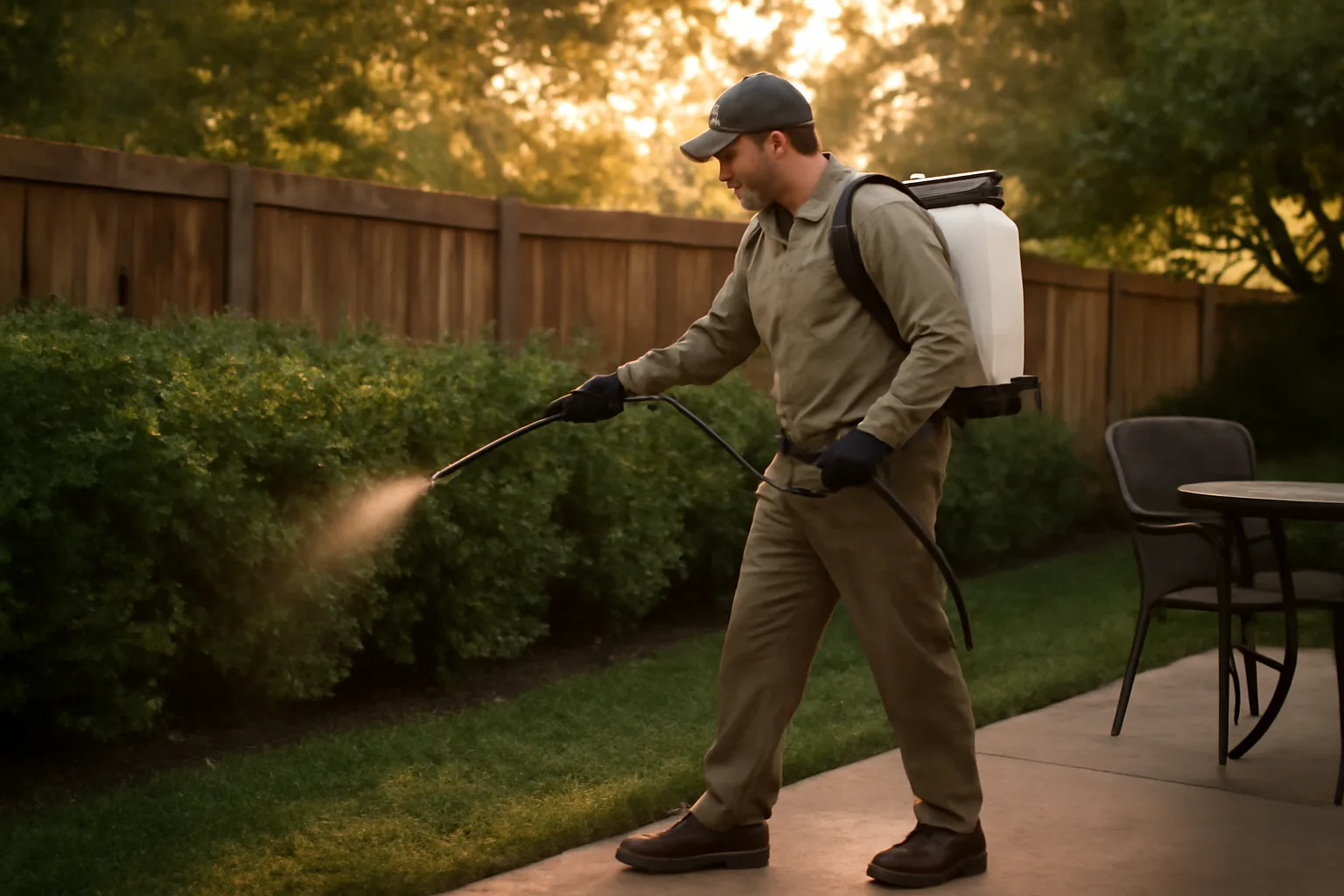
Commercial mosquito control usually means a technician applying an EPA-registered barrier spray to vegetation every 10 to 14 days, or an installed misting system on a timer. Neither eliminates mosquitoes; both knock populations down significantly when paired with removing standing water. Expect $50-$100 per visit for barrier service or $1,500-$6,000+ installed for misting systems.
What does commercial mosquito control actually involve?
Commercial mosquito control means a paid service (not a DIY spray you buy at the hardware store) that reduces mosquito populations on your property through repeated treatment. Most companies use one of two delivery methods: a technician who shows up on a schedule and sprays vegetation by hand, or a plumbed-in misting system that fires on a timer without anyone visiting at all. The backbone of almost every service is a barrier treatment. A technician applies an EPA-registered pesticide, often a synthetic pyrethroid like bifenthrin or permethrin, to the underside of leaves, shrub lines, mulch beds, and shaded resting spots where adult mosquitoes hide during the day. Mosquitoes land on treated surfaces and die or are knocked down over the following hours and days. This is not a fog that kills mosquitoes on contact mid-flight; it is a residual layer that keeps working after the truck leaves. Federal pesticide law requires that products be used consistent with their label. Under the Federal Insecticide, Fungicide, and Rodenticide Act, "it shall be unlawful for any person to use any registered pesticide in a manner inconsistent with its labeling" (7 U.S.C. § 136j(a)(2)(G)) [1]. A legitimate company applies per label and can tell you exactly what active ingredient they use and where. Source reduction, meaning eliminating standing water where mosquitoes lay eggs, is the other half of any real program. The CDC's guidance is blunt about this: mosquitoes need as little as a bottle cap of water to breed, and eliminating that water is one of the most effective steps a homeowner can take [2]. No barrier spray substitutes for dumping out a clogged gutter or a saucer under a potted plant.
How to get rid of mosquitoes in the yard: barrier spray vs misting systems
| Typical cost | $50-$100/visit, ~$400-$1,200/season | $1,500-$6,000+ installed, plus refills | |
|---|---|---|---|
| Schedule | Every 10-14 days | Automated, daily or set schedule | |
| Hardware | None | Pump, reservoir, nozzles installed | |
| Weather flexibility | Technician can reschedule around rain | Fires on timer regardless | |
| Best for | Most residential yards | Large lots, frequent outdoor entertaining | Neither method eliminates mosquitoes from a property. Both are population suppression tools. If a neighbor two lots over has a swamp of standing water, some mosquitoes will always find their way to your patio during peak activity hours. For a broader look at how these methods compare to yard-and-plant strategies, see mosquito control. |
Both approaches work by the same chemistry, mostly pyrethroids or sometimes botanical actives, but they differ in cost, convenience, and how much control you have over when chemical goes down. Barrier spray service means a technician visits on a cycle, typically every 10 to 14 days during mosquito season, and treats vegetation, fence lines, and other resting areas by backpack or truck-mounted sprayer. Cost generally runs $50 to $100 per visit depending on lot size and region, or somewhere in the $400 to $1,200+ range for a full season of visits. It requires no permanent hardware and nothing to maintain between visits, but you're on someone else's schedule and a rained-out visit means a gap in coverage. Misting systems are permanently installed: a reservoir and pump connect to a network of nozzles hidden in landscaping, and the system fires automatically at dawn and dusk (or on a schedule you set) without anyone coming to your door. Installed cost is substantially higher, commonly $1,500 to $6,000 or more depending on yard size and nozzle count, plus a refill and maintenance contract. The tradeoff is convenience and consistency versus a bigger upfront bill and more chemical going into the yard on a fixed timer rather than an as-needed basis. | Feature | Barrier spray service | Misting system |
How to get rid of mosquitoes in the house
Indoor mosquitoes almost always trace back to an entry point (a torn screen, a door left open at dusk) or, less often, a breeding site inside the home itself, like water sitting in a houseplant saucer, a humidifier reservoir, or a clogged AC drain line. Start by walking the house at dusk, when mosquitoes are most active, and watching where they seem to be getting in. Check screens for tears, gaps under exterior doors, and any window that doesn't seal fully. A single quarter-inch gap is enough for the smaller mosquito species to slip through. For active mosquitoes already inside, an indoor aerosol labeled for flying insects, used per label directions in a ventilated room, will knock down what's present. A box fan pointed at a doorway also works surprisingly well as a physical barrier since mosquitoes are weak fliers and struggle against moving air, a trick mentioned by several university extension mosquito guides as a non-chemical option for porches and open doorways. If mosquitoes keep reappearing indoors day after day, look for an indoor breeding source rather than assuming they're all flying in from outside. Check saucers under houseplants, the tray under a window AC unit, and anywhere condensation collects. Mosquitoes can complete their egg-to-adult cycle in as little as 7 to 10 days in warm water, so even a small forgotten container can sustain an indoor population [3].
How to keep mosquitoes away long term
Keeping mosquitoes away is a maintenance habit, not a one-time fix. The CDC and most state extension services frame it around three repeating actions: tip out standing water on a weekly cycle, maintain any chemical barrier treatment on its schedule, and reduce the vegetation and shade that give adult mosquitoes places to rest during the day [2]. Walk the property once a week during mosquito season and dump anything holding water for more than a few days: saucers, buckets, tarps, kiddie pools, birdbaths (refresh these every few days), and low spots in gutters. This single habit does more for long-term control than almost anything sprayed from a truck, because it attacks mosquitoes before they exist rather than after. Keep grass mowed short and shrubs trimmed back from walking paths. Female mosquitoes rest in cool, humid, shaded vegetation between blood meals, and thinning that habitat reduces the population that a barrier spray even needs to reach. Screened porches, ceiling fans over patios, and citronella candles all help at the margins but none of them is a substitute for source reduction. For a property with a real mosquito problem, the honest long-term answer is layering: source reduction every week, a barrier treatment or misting system every 10 to 14 days through the season, and personal repellent for the gap in between. If you're deciding between DIY and hiring it out, mosquito control near me walks through what to ask a local company before you sign anything.
What plants repel mosquitoes, and do they actually work?
A mosquito repellent plant is any plant whose natural oils are thought to deter mosquitoes, usually because the plant contains compounds like citronellal, geraniol, or linalool. The most commonly cited ones are citronella grass, lavender, marigold, catnip, lemon balm, rosemary, and basil. The honest answer on whether they work: the oils inside these plants do have measurable repellent activity in lab settings, but an intact, unbruised plant sitting in a pot releases very little of that oil into the air. University extension entomologists are consistent on this point, that repellent plants provide, at best, a minor and localized effect, and nowhere near what a registered repellent applied to skin or clothing (or a barrier treatment applied to the yard) provides. If you want to try it, plant citronella grass, lavender, or lemon balm in beds near seating areas, and crush a few leaves occasionally to release more oil. Think of it as a mild, pleasant-smelling supplement to real control, not a mosquito control strategy on its own. For a rundown of specific plants and where to place them, see natural mosquito repellent.
When do mosquitoes go away for the season?
Mosquitoes go dormant or die off once nighttime temperatures consistently drop below the mid-50s Fahrenheit, but the exact timing varies enormously by region and species, so treat any calendar date as a rough guide rather than a rule. In the Upper Midwest and Northeast, mosquito activity typically tapers off with the first hard frosts, often in October. In the Deep South, Gulf Coast, and much of California and the Southwest, mosquitoes can remain active nearly year-round in mild winters, especially in years without a sustained cold snap. Some species, like Culex, overwinter as adults in sheltered spots (culverts, crawl spaces, storm drains) and can become active again on unseasonably warm winter days. Rather than relying on a fixed date, check your local mosquito control district or state extension service for regional guidance, since they track actual trap counts and can tell you when local activity has genuinely dropped versus when it just feels cooler outside. If you're timing the end of a seasonal barrier program, the safest marker is several consecutive nights below 50°F, not the calendar.
How to get rid of ticks in the yard and on your property
Tick control in a yard works on a different mechanism than mosquito control because ticks don't fly to you, they climb onto you as you walk through vegetation, so the fix focuses on the specific zones where ticks quest for hosts rather than the whole property. The CDC recommends creating a tick-safe zone with a wood chip or gravel barrier between lawn and any wooded or brushy area, since the vast majority of ticks stay close to the woodland edge and rarely cross a dry, sunny buffer. CDC guidance states that placing "a 3-ft-wide barrier of wood chips or gravel between lawns and wooded areas will restrict tick migration into recreational areas" [4]. Keep grass mowed short, clear leaf litter and brush, and stack firewood in a dry, sunny spot rather than in shade, since ticks need humidity to survive. Granular or liquid acaricide treatments (products containing bifenthrin or permethrin, applied to the lawn perimeter, leaf litter edges, and stone walls) are the commercial answer for actual tick population reduction and are typically applied on a similar 2 to 4 times per season schedule rather than the tighter mosquito cycle. Because ticks live in leaf litter and shaded edges rather than in the open lawn, spraying the whole yard uniformly wastes product; CDC guidance on landscaping and pesticides specifically calls out treating the yard edge and perimeter rather than the entire lawn [4]. Deer are a major tick host for the blacklegged tick (the primary vector for Lyme disease in the Northeast and upper Midwest), so fencing them out of a yard, where feasible, and removing brush piles that shelter mice (another key host) both help over time. For personal protection layered on top of yard treatment, see tick repellent.
How do you get rid of ticks from your yard specifically (more than prevent them)?
Getting rid of an existing tick population in a yard combines habitat modification with targeted acaricide application, done in the right order and on the right schedule, since neither step alone reliably knocks numbers down. First, do the habitat work: mow tall grass, clear leaf litter, thin brush along wood edges, and install that wood-chip or gravel buffer between lawn and woods. This alone can meaningfully reduce tick numbers because it removes the humid, shaded microclimate ticks need to avoid drying out. Second, apply an EPA-registered acaricide to the identified tick zones: the woodland edge, stone walls, leaf litter, and any area with tall grass or brush, not the open mowed lawn where ticks rarely venture. A single application knocks down existing ticks but does not prevent new ones from moving in from a neighboring property or from wildlife, so most professional tick programs run several treatments through spring and summer, timed around the nymphal tick season. CDC guidance on Lyme disease transmission notes that nymphs are active mainly in spring and summer months and are responsible for most human infections because their small size makes them hard to detect [5]. Third, treat it as an ongoing program, not a one-time fix. A yard bordering woods or a field with a deer population will get reinfested from the edges every season no matter how thorough one treatment was, so a seasonal recheck matters more than the strength of any single spray.
How often should a professional mosquito barrier treatment be reapplied?
Most professional barrier treatments are reapplied every 10 to 14 days during active mosquito season, which is the window in which the residual pyrethroid activity on treated foliage meaningfully breaks down and new leaf growth goes untreated. Rain accelerates this: a heavy rainfall within 24 to 48 hours of application can wash a meaningful amount of product off treated leaves, which is why a company that skips visits after storms, or offers a free re-treat after heavy rain, is generally doing it right rather than being lax. New plant growth is also untreated by definition, so a yard that's growing fast in spring may need slightly tighter intervals than one in late summer. A seasonal plan on that 10-to-14-day cycle, layered with weekly source reduction on your end, is the model most companies (including us at Duskproof) build a program around: a free yard assessment first to map standing water and resting sites, then a recurring visit schedule sized to your property and local mosquito pressure. If you want to see what that looks like for your yard specifically, get a free yard assessment.
Are commercial mosquito treatments safe for pets, kids, and pollinators?
This is the question every homeowner should ask before hiring anyone, and the honest answer depends on the product, the application, and the timing, not a blanket yes. EPA registration means a product has been evaluated for the uses on its label and can legally be sold and applied per those directions; it is not a certification that the product is harmless in all circumstances. Federal law itself only permits use "consistent with its labeling" (7 U.S.C. § 136j(a)(2)(G)) [1], and the label is where any restrictions on reentry timing, pets, and application near water live. A responsible company will tell you the active ingredient, keep you and pets off treated surfaces until the spray dries (typically a few hours), and avoid direct treatment of blooming flowers where pollinators are actively foraging. Pyrethroids, the most common class used in residential barrier treatments, are generally considered to have low mammalian toxicity at label rates but are notably toxic to bees and other pollinators, aquatic invertebrates, and fish, which is why label directions restrict application near water and blooming plants and specify not to spray during active pollinator visitation [6]. Ask any company you're considering exactly which active ingredient they use, whether they avoid flowering plants, and what the label's reentry interval is. If they can't answer specifically, that's a red flag.
DIY vs hiring a commercial mosquito control company: what's actually worth it?
The honest comparison depends on lot size, how bad the problem is, and how much time you're willing to spend on a recurring chore, not on whether professional service is inherently better. DIY works reasonably well for smaller, well-maintained yards where the homeowner is genuinely diligent about weekly water removal and is willing to buy and apply a consumer-grade hose-end or backpack sprayer every couple of weeks. It's cheaper up front (a season of consumer product might run $100 to $300) but it's easy to fall behind on the schedule, and consumer sprayers often don't reach the same coverage or concentration a commercial backpack or truck rig delivers. Professional service makes more sense for larger properties, yards backing up to woods or wetlands, anyone hosting frequent outdoor events, or households where someone has a real health concern around mosquito-borne disease exposure. You're paying for consistency (someone else tracking the 10-to-14-day cycle so you don't have to), commercial-grade equipment, and, with a misting system, near-total automation. Neither option eliminates mosquitoes. Anyone promising total eradication from a residential yard is overselling it; wind, neighboring properties, and mosquito flight range (some species can travel a mile or more from breeding sites) mean total elimination isn't realistic even with weekly professional visits. What both good DIY and good professional programs deliver is a meaningfully lower population and more usable outdoor evenings, which for most homeowners is the actual goal. See mosquito for more on species behavior and flight range that shapes these limits.
Frequently asked questions
How do I get rid of mosquitoes fast in my backyard?
There's no truly instant fix, but the fastest combination is dumping every container of standing water immediately, then applying an EPA-registered barrier spray to shaded vegetation and resting areas. A professional barrier treatment typically knocks down active adult mosquitoes within hours to a day, with residual protection continuing for roughly 10 to 14 days afterward.
How to get rid of mosquitoes in the house overnight?
Use a labeled indoor aerosol for flying insects in the room, per label directions, then check screens and door seals for gaps before bed. A box fan pointed across a doorway also helps, since mosquitoes fly weakly and struggle against moving air. If mosquitoes keep appearing nightly, look for an indoor water source like a plant saucer or AC drain tray.
What plants repel mosquitoes the best?
Citronella grass, lavender, lemon balm, marigold, catnip, and rosemary are the most commonly cited mosquito repellent plants because they contain oils like citronellal and geraniol. University extension research is clear that an intact potted plant releases only a small amount of these compounds, so plants provide a mild supplement to control, not a substitute for barrier treatment or source reduction.
How do you get rid of ticks from your yard?
Create a buffer of wood chips or gravel between lawn and any wooded edge, mow grass short, clear leaf litter, and apply an EPA-registered acaricide to the woodland edge and brushy zones rather than the open lawn. CDC guidance notes tick populations concentrate near woodland edges, so targeted edge treatment beats spraying the whole yard uniformly.
When do mosquitoes go away for the year?
Most mosquito activity drops off once nighttime temperatures consistently fall below the mid-50s Fahrenheit, often with the first hard frost in northern states (commonly October) but much later, or not at all, in the Deep South and Southwest. Check your local mosquito control district for actual trap data rather than relying on a calendar date.
How often does a mosquito barrier spray need to be reapplied?
Every 10 to 14 days during active mosquito season is the standard cycle most commercial programs use, since residual pyrethroid activity breaks down over that window and new, untreated plant growth appears. Heavy rain within a day or two of application can shorten that window and may call for an earlier re-treat.
Do misting systems work better than barrier spray service?
Misting systems automate the same chemistry a technician applies by hand, firing on a preset schedule without visits. They cost significantly more upfront (often $1,500 to $6,000+ installed versus $50-$100 per barrier visit) but offer more consistent coverage and no dependence on a technician's route schedule. Neither method eliminates mosquitoes; both suppress populations.
Is commercial mosquito spray safe for pets and kids?
EPA registration means a product is approved for labeled uses when applied correctly, not that it's certified harmless in every situation. Keep people and pets off treated surfaces until the spray fully dries, typically a few hours, and ask your provider which active ingredient they use and what the label's reentry interval specifies.
How do I keep mosquitoes away from my patio during a party?
Combine a barrier treatment applied a day or two before the event with fans running on the patio (mosquitoes are weak fliers), citronella candles or torches for ambiance rather than reliance, and long sleeves after dusk. None of these alone gives full protection, but layered together they meaningfully cut mosquito activity around seating.
What's the difference between mosquito control and tick control in a yard?
Mosquito control targets flying adults resting in shaded vegetation across the whole property, typically on a 10-14 day spray cycle. Tick control targets a much narrower zone, the woodland edge and leaf litter where ticks quest for hosts, using acaricide applied a few times per season rather than the tighter mosquito cycle.
Can I get rid of mosquitoes without chemicals?
You can meaningfully reduce mosquitoes without chemicals by eliminating all standing water weekly, since the CDC notes mosquitoes need as little as a bottle cap of water to breed, and by keeping grass short and shrubs trimmed to reduce daytime resting spots. This won't match the population knockdown of a barrier treatment, but it's the single highest-leverage non-chemical step.
How much does professional mosquito control cost?
Barrier spray service typically runs $50 to $100 per visit, or roughly $400 to $1,200 for a full season on a 10-14 day cycle, depending on property size and region. Installed misting systems cost substantially more, often $1,500 to $6,000 or more, plus ongoing refill and maintenance costs.
Sources
- Federal Insecticide, Fungicide, and Rodenticide Act, 7 U.S.C. § 136j(a)(2)(G): EPA-registered pesticides must be applied per label directions; using a product inconsistent with its label violates federal law
- CDC, Controlling Mosquitoes at Home: Mosquitoes need as little as a bottle cap of water to breed; eliminating standing water is a top control step
- CDC, Mosquito Life Cycle: Mosquitoes can complete their egg-to-adult life cycle in as little as about a week in warm water
- CDC, Preventing Tick Bites on People: Creating a wood chip or gravel barrier between lawn and woods, and treating perimeter/edge habitat rather than the whole yard, reduces tick exposure more efficiently
- CDC, Lyme Disease Transmission: Nymphal blacklegged ticks, active mainly in spring and summer, are responsible for most Lyme disease transmission due to their small size
- National Pesticide Information Center, Permethrin Technical Fact Sheet: Pyrethroids used in residential mosquito control are toxic to aquatic invertebrates, fish, and bees, which is why label directions restrict application near water and blooming plants