Last updated 2026-08-14
TL;DR
There's no single best yard insect repellent. Skin repellents like DEET or picaridin protect people for hours; yard-wide protection needs source reduction (dumping standing water) plus a barrier spray on vegetation every 2 to 3 weeks. Plants and citronella candles help a little, not much. Combine both approaches for real results.
What actually is the best yard insect repellent?
There isn't one product that does the whole job. Anyone selling you a single spray or gadget as the complete answer is skipping steps. The best results come from layering three things: getting rid of standing water where mosquitoes breed, applying a barrier spray to the vegetation where adult mosquitoes and ticks rest during the day, and using a personal repellent on your skin when you're actually outside. The EPA's own guidance on mosquito control describes this as an integrated approach, not a single product decision. Barrier sprays (often pyrethroid-based, applied to shrubs, tall grass, and shaded areas) knock down the resting adult population for roughly 2 to 3 weeks per application, which is why professional programs run on a repeat cycle rather than a one-time visit. If you want the short version: source reduction is free and does the most long-term good, a barrier treatment on a 10 to 14 day cycle handles the adults that are already there, and a personal repellent covers the gap when you're sitting on the patio at dusk. None of these eliminate mosquitoes or ticks from your property. They knock the population down enough that you stop getting eaten alive.
How to get rid of mosquitoes in the yard
Start with water, not spray. Mosquitoes need standing water to complete their life cycle, and the CDC notes that some species can go from egg to biting adult in as little as 7 to 10 days depending on temperature [1]. Check gutters, plant saucers, tarps, kiddie pools, birdbaths, and anything that holds water for more than a few days after rain. After you've dealt with water sources, treat the vegetation. Adult mosquitoes rest on the undersides of leaves in shaded, humid spots during the day: think ivy, hostas, the underside of deck railings, tall grass at the property line. A barrier spray applied to those resting sites is what actually reduces the biting population outdoors, as opposed to a fogger that just clears the air for an hour. Mosquito dunks (containing the larvicide Bti) are worth using in anything you can't drain, like a rain barrel or ornamental pond. Bti is a naturally occurring soil bacterium that the EPA has registered as a larvicide, and it targets mosquito larvae specifically without the broad-spectrum kill of a barrier spray [2]. For most suburban yards, a repeat barrier treatment on a 10 to 14 day cycle through the season, combined with weekly water checks, is the combination that keeps the population down. This is the model most professional mosquito control programs run on, because a single application fades fast once new adults emerge from anything you missed.
How to keep mosquitoes away from your patio or deck
For an evening outside, personal repellent and airflow do more than any gadget marketed for this. A box fan or outdoor fan disrupts mosquito flight, which is weak compared to wind; this is a commonly cited, low-cost trick from extension entomologists, though the effect is about disrupting flight, not repelling. On the chemical side, the CDC and EPA recommend registered active ingredients: DEET, picaridin, IR3535, oil of lemon eucalyptus (OLE, the synthesized version, not raw essential oil), 2-undecanone, and para-menthane-diol [3]. These are the ingredients with actual efficacy data behind them, tested for hours of protection rather than anecdote. Citronella candles and tiki torches provide some localized reduction in bites but nowhere near what a barrier spray or personal repellent does. Most studies show a modest, short-radius effect that fades as you move a few feet from the flame. They're fine as an addition to a patio setup. They're not a replacement for treating the yard. If you're comparing personal mosquito repellent products for skin use versus a yard-wide barrier plan, understand they solve different problems: one protects the person, the other reduces the population you're being protected from.
How to get rid of ticks in the yard
Ticks don't fly and they don't jump; they climb tall grass and shrubs and wait for a host to brush past, a behavior called questing. That means the fix starts with landscaping, not spray. Keep grass mowed short, clear leaf litter and brush, and create a buffer of wood chips or gravel (the CDC recommends at least a 3-foot-wide barrier) between lawn and wooded edges to physically limit tick migration into the yard [4]. Barrier sprays targeting tick habitat (the shaded edges, stone walls, wood piles, and tall grass borders) reduce tick populations in treated zones. Connecticut Agricultural Experiment Station research on residential properties has shown that a single, well-timed application to the yard perimeter can reduce tick numbers substantially through the season, though results vary by property and species [5]. Deer are a major host for adult ticks, so reducing deer access (fencing, removing deer-attracting plants) helps over time, though it's a bigger project than most homeowners take on. Free-range chickens and guinea fowl get mentioned online as tick control; there's limited hard data supporting this at a level that would replace an actual treatment plan. For the actual how-do-you-get-rid-of-ticks-from-your-yard question: mow, clear brush, create a dry barrier zone at the woodline, and apply a barrier treatment to the tick habitat on a repeat schedule through spring and fall when nymphs and adults are most active. A dedicated tick repellent on skin and clothing (permethrin-treated clothing plus a DEET or picaridin skin product) covers you personally when you're in the yard or hiking.
What is a mosquito repellent plant, and do they actually work?
A mosquito repellent plant is any plant whose natural oils are claimed to deter mosquitoes, usually because the plant contains compounds like citronellal, geraniol, or eucalyptol. Common examples include citronella grass, lemon balm, marigolds, lavender, catnip, and rosemary. The honest answer: growing these plants in your yard does very little on its own. The repellent effect comes from the oil being extracted, concentrated, and applied to skin, not from the living plant sitting in a pot. A marigold bed smells nice and might have a marginal, extremely localized effect, but it is not a substitute for source reduction or a barrier treatment. If you like the idea of a repellent garden, plant it and enjoy it. Just don't expect it to replace dealing with standing water in your yard, since that decision affects mosquito numbers far more than any planting choice will.
What plants repel mosquitoes the most?
| Citronella grass (potted/planted) | Living plant | Minimal, localized at best | |
|---|---|---|---|
| Citronella candles/torches | Extracted oil, burned | Modest, short radius | |
| Catnip/lemon balm/marigolds | Living plant | Minimal, largely anecdotal | |
| DEET or picaridin (skin) | EPA-registered repellent | Hours of documented protection [3] | |
| Barrier spray (yard) | EPA-registered pesticide | Reduces resting adult population for 2-3 weeks | If you're planting for repellency, treat it as a nice-to-have alongside a real plan, not the plan itself. |
Among the commonly cited options, citronella grass (Cymbopogon nardus), lemon eucalyptus, lemongrass, and catnip (Nepeta cataria) contain the highest concentrations of the compounds associated with repellency. Catnip in particular has been studied for its nepetalactone content, which lab research has shown to have repellent properties against mosquitoes in controlled settings; field performance in an actual yard is a different story and much less studied. Here's a rough comparison of the commonly recommended plants versus registered repellent actives, based on what extension and EPA sources actually say about effectiveness: | Option | Type | Real-world effect |
How to get rid of mosquitoes in the house
Indoor mosquitoes usually mean one of two things: they're coming in through gaps (doors, screens, vents) or they're breeding somewhere inside, which is less common but does happen in things like plant saucers, unused humidifiers, or a clogged floor drain. Check window and door screens for tears, and make sure screens are actually latched, more than resting in the frame. A single mosquito indoors overnight ruins sleep for a lot of people, so it's worth the five minutes to check. For active mosquitoes already inside, a household aerosol labeled for indoor flying insects, used per the label, will handle what's already in the room. Plug-in repellents using registered actives can help in a bedroom overnight. Standing water indoors (even a saucer under a houseplant that's sat too long) can support larvae in about a week under the right conditions, so if you're getting repeat indoor mosquitoes with sealed screens, look for a water source before assuming they're coming from outside [1]. The question of how to get rid of mosquitoes in the house really comes back to two checks: seal the entry points, and eliminate any standing water, however small, inside the home.
When do mosquitoes go away for the season?
Mosquito activity drops off once temperatures fall consistently below about 50°F, since most species become inactive or enter diapause (a dormant state) below that threshold . Exactly when that happens depends entirely on where you live: parts of the Gulf Coast and southern Florida see mosquito activity nearly year-round, while northern states may see activity end by mid-to-late October and not resume until May. Because the range is wide and shifts year to year with weather patterns, check your local extension service or health department for the seasonal window that applies to your area. That's also the right resource to confirm which mosquito species are active locally, since some carry more disease risk than others (Culex and Aedes species are the ones most often flagged in public health guidance). This is why seasonal barrier programs are typically timed to your regional first-frost and last-frost dates rather than a fixed calendar month. A program that starts in April in Georgia would start weeks later in Minnesota, and stopping treatment too early in a warm fall just gives the population a chance to rebound before the season actually ends.
How do barrier sprays and misting systems compare?
| Upfront cost | Low to none (per-visit pricing) | Higher (equipment + install) | |
|---|---|---|---|
| Ongoing cost | Recurring per-visit fee | Refill/maintenance cost | |
| Application frequency | Every 10-14 days typical | Automated, timed daily/dusk-dawn | |
| Coverage control | Technician targets resting sites | Fixed nozzle placement | |
| Best for | Most residential yards | Heavy-use outdoor living spaces | Neither approach eliminates mosquitoes from a property; both reduce the population that's biting you while you're outside. Which one makes sense depends on your yard's layout, how much you use the outdoor space, and your budget. A natural mosquito repellent approach using plant oils and habitat changes can supplement either system but isn't a substitute for one on its own. |
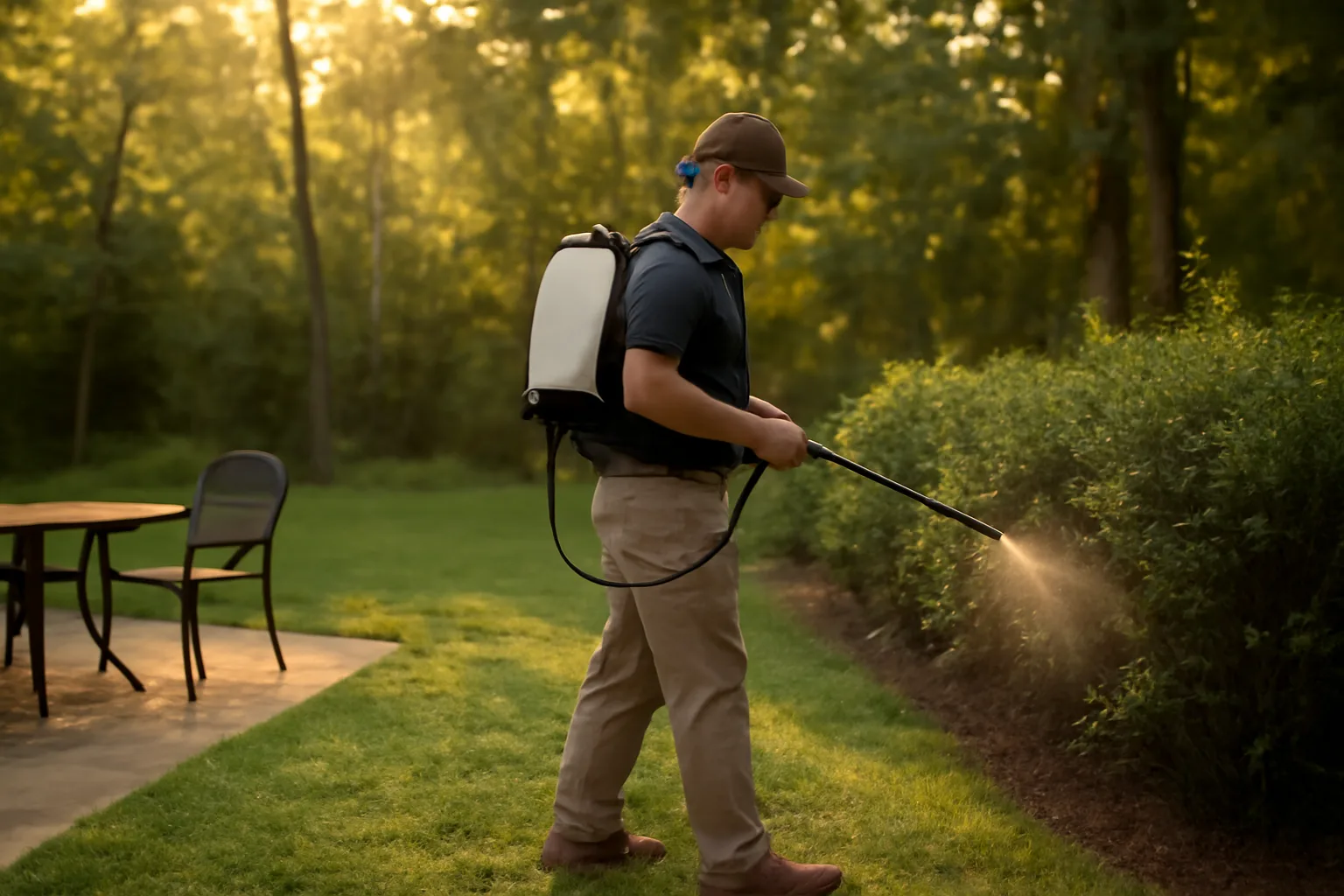
A barrier spray is a liquid application, typically a pyrethroid, applied by hand or backpack sprayer to the vegetation, foundation, and shaded resting areas around a property. It's reapplied on a cycle, commonly every 2 to 3 weeks, because the residual effectiveness fades with UV exposure, rain, and plant growth. A misting system is a fixed installation: nozzles plumbed around the property that release a fine mist of repellent or insecticide on a timer or remote trigger, usually at dawn and dusk when mosquitoes are most active. It costs more upfront and involves fixed infrastructure, but it needs less manual labor per application once installed. | Feature | Barrier spray (technician visit) | Installed misting system |
Do ultrasonic devices, bug zappers, and traps actually work?
Ultrasonic mosquito repellent devices, the plug-in or clip-on kind that claim to emit sound frequencies mosquitoes hate, have been tested repeatedly with no consistent evidence they reduce bites. This has been a known result in entomology research going back decades, and it hasn't changed with the newer wearable versions. Bug zappers (the purple-light electric grid kind) mostly kill non-biting insects. Multiple studies have found mosquitoes make up a small fraction, often under 10 percent, of what they actually kill. You end up removing a lot of moths and beetles, not the mosquitoes on your ankles. CO2 and octenol traps that mimic human breath can reduce local mosquito numbers over time in a yard, but they work slowly, need consistent placement and maintenance, and are best used as one piece of an integrated plan rather than the centerpiece.
What does a professional mosquito and tick yard program actually involve?
A typical service starts with a free walk-through of the property to identify standing water, resting vegetation for mosquitoes, and tick habitat like woodline edges and stone walls. From there, most residential programs settle on a barrier spray applied every 10 to 14 days through the active season, timed to your local climate, or an installed misting system for properties with heavy outdoor use. What a program should not promise is elimination. Any legitimate provider will tell you a barrier treatment knocks the population down; it doesn't wipe out mosquitoes or ticks from a wooded suburban lot, because new adults keep emerging from surrounding untreated land and standing water you can't control. Products used in these programs are EPA-registered pesticides applied according to their label instructions; that's a regulatory standard, not a safety guarantee, and the label itself is what governs application rates, reentry intervals, and areas of use. At Duskproof, our free yard assessment covers exactly this: mapping standing water, resting sites, and tick zones on your property before recommending a barrier cycle or misting install, so you're not paying for more coverage than your yard actually needs. If you want that walk-through, get a free yard assessment.
How much does professional mosquito and tick control cost?
Pricing varies a lot by region, lot size, and whether you're choosing per-visit barrier treatments or an installed misting system, so any number you see online (including this one) should be treated as a rough range, not a quote. Per-visit barrier treatments for an average suburban lot commonly run in the range that a local provider will quote after seeing the property, since lot size, vegetation density, and treatment radius all move the price. Installed misting systems cost more upfront because of the equipment and installation labor, offset over time by less recurring labor per treatment. The only way to get an accurate number for your actual property is a walk-through quote, since a quarter-acre open lawn and a wooded half-acre with a creek behind it are entirely different jobs. This is also why we don't sell anything through an online checkout: yard size, vegetation, and standing water vary too much for a flat price to mean anything. A free yard assessment gets you a real number for your property instead of a guess.
Frequently asked questions
How do I get rid of mosquitoes fast in my backyard?
There's no truly instant fix, but the fastest combination is dumping all standing water immediately, then applying a barrier spray to shaded vegetation where adults rest. A barrier treatment typically reduces the resting adult population within a day or two and holds for about 2 to 3 weeks before needing reapplication.
How do you get rid of ticks from your yard?
Mow grass short, clear leaf litter and brush, and build a 3-foot-wide barrier of wood chips or gravel between lawn and wooded edges, a spacing recommended by the CDC to limit tick migration. Add a barrier spray targeting the woodline and stone walls, since that's where ticks quest for hosts.
What plants repel mosquitoes the most effectively?
Citronella grass, lemon eucalyptus, lemongrass, and catnip contain the highest concentrations of repellent-associated compounds, but living plants provide only a minimal, localized effect. The extracted oils, concentrated into products applied to skin or burned as candles, do more than the plants growing in a pot or garden bed.
When do mosquitoes go away for the year?
Most mosquito species become inactive once temperatures stay consistently below about 50°F. Timing varies widely by region, from near year-round activity along the Gulf Coast to a season ending by mid-October in northern states, so check your local extension service or health department for your area's typical window.
How do I get rid of mosquitoes in my house?
Check window and door screens for gaps or tears, since that's the most common entry point. Eliminate any standing water indoors, even small plant saucers, since larvae can develop in about a week. For mosquitoes already inside, a household aerosol labeled for flying insects, used per the label, handles the immediate problem.
What's the difference between a barrier spray and a misting system?
A barrier spray is a technician-applied liquid treatment to vegetation and resting sites, reapplied every 10 to 14 days. A misting system is a fixed, plumbed installation with nozzles that release repellent on a timer, usually at dawn and dusk, needing less manual labor per application but costing more to install.
Do citronella candles actually keep mosquitoes away?
They provide a modest reduction in bites within a short radius of the flame, but the effect drops off quickly with distance and doesn't compare to a barrier spray or a personal repellent with an EPA-registered active ingredient like DEET or picaridin. Use them as a patio addition, not a primary control method.
Do bug zappers actually reduce mosquito bites?
Not much. Multiple studies have found mosquitoes make up a small share, often under 10 percent, of what bug zappers actually kill; most of their catch is moths, beetles, and other non-biting insects that happen to be attracted to the light.
What is a mosquito repellent plant?
It's a plant, like citronella grass, lemon balm, or catnip, that produces natural oils containing compounds such as citronellal or nepetalactone associated with repelling mosquitoes. Living plants provide only a minor, localized effect; the concentrated extracted oils used in products do considerably more.
How often should a yard be treated for mosquitoes?
Most barrier treatment programs run on a 10 to 14 day cycle through the active mosquito season, since residual effectiveness fades with UV exposure, rain, and new plant growth. An installed misting system runs on an automated daily or dusk-and-dawn timer instead of a manual reapplication cycle.
Can I get rid of mosquitoes and ticks without chemicals?
You can meaningfully reduce both without pesticides by eliminating standing water, mowing regularly, clearing leaf litter, and creating a dry buffer zone at wooded edges. This won't eliminate either pest, but combined with personal repellent use, it noticeably cuts exposure without any yard-wide chemical application.
Are mosquito dunks safe to use around pets and kids?
Mosquito dunks contain Bti, a naturally occurring bacterium the EPA has registered specifically as a larvicide targeting mosquito larvae. They're intended for standing water like rain barrels and ponds and are applied according to the product label; follow that label rather than assuming any product is automatically safe for all uses.
Sources
- CDC, Mosquito Life Cycle: Mosquitoes can complete egg-to-adult development in about 7 to 10 days depending on temperature
- EPA, Find the Repellent that is Right for You: EPA-registered repellent active ingredients include DEET, picaridin, IR3535, oil of lemon eucalyptus, 2-undecanone, and PMD
- CDC, Preventing Tick Bites on People: A 3-foot-wide barrier of wood chips or gravel between lawn and wooded areas restricts tick migration into yards
- Connecticut Agricultural Experiment Station, Tick Management Handbook (Stafford, 2007): Single well-timed yard perimeter treatments can substantially reduce residential tick populations through the season
- PubMed, "Plant-Based Repellent and Insecticidal Essential Oils" (PMID: 27538039): Research review frames plant-based repellent compounds as offering limited, variable protection compared to registered synthetic repellents
- PubMed, Bernier et al., catnip oil and nepetalactone mosquito repellency study (PMID: 15825769): Nepetalactone in catnip has shown repellent properties against mosquitoes in laboratory research
- CDC, Surveillance and Control of Aedes aegypti and Aedes albopictus in the United States: Mosquito activity drops sharply once temperatures fall consistently below about 50 degrees Fahrenheit