Last updated 2026-08-14
TL;DR
Local mosquito spraying (a barrier treatment sprayed on vegetation and resting sites) typically runs $50-$150 per visit on a 14-to-21-day cycle through the season, per NPMA guidance. It knocks populations down for two to three weeks; it doesn't eliminate mosquitoes. Pair it with standing-water removal, and confirm any company is licensed with your state pesticide regulator before booking.
What does "mosquito spraying near me" actually mean?
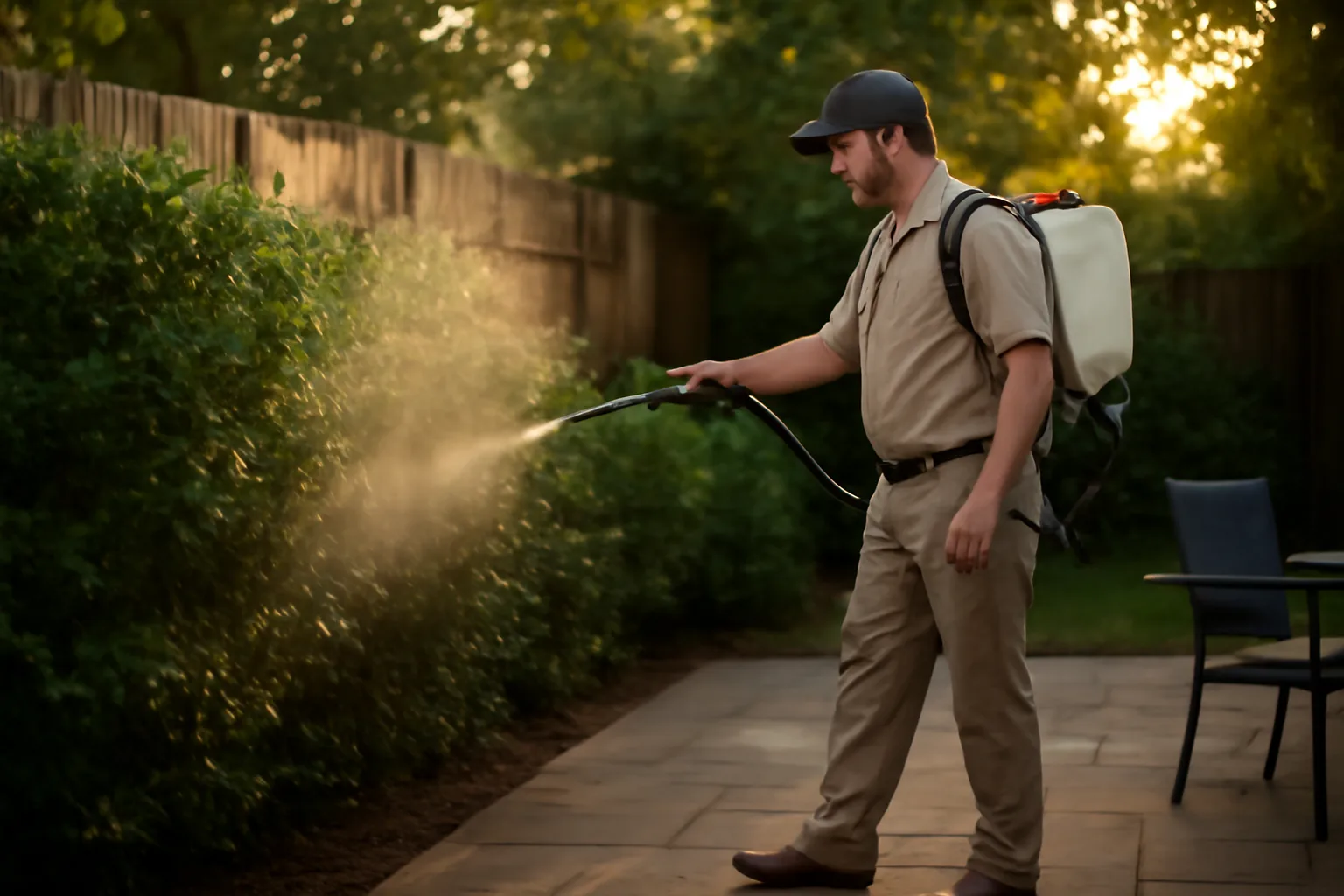
When people search this, they usually mean one of two services: a barrier spray (a technician walks the property and treats shrubs, tall grass, fence lines, and shaded resting spots with an EPA-registered pesticide) or an installed misting system (fixed nozzles plumbed around the yard that release a fine spray on a timer or remote trigger). Both target adult mosquitoes where they rest during the day, more than the ones flying around at dusk. A barrier treatment isn't a one-time fix. Most residual products break down within 2 to 3 weeks depending on the active ingredient, sun exposure, and rainfall, which is why local companies sell it as a recurring service on a cycle, not a single visit [1]. The other thing "near me" searches turn up is mosquito abatement districts, which are public agencies, not private companies. Many counties and cities run their own control programs, especially in the South and parts of the West, and some will treat public land or do larval control in storm drains for free. Check whether your county has one before assuming you need a private contractor for everything [2].
How much does professional mosquito spraying cost?
| Single barrier spray visit | $50-$150 | Per visit | 2-3 weeks | |
|---|---|---|---|---|
| Seasonal barrier program | $450-$1,200 | Every 14-21 days | Full season | |
| Misting system install | Low thousands (varies by yard) | One-time + refills | Automated, ongoing | |
| DIY backpack sprayer | $30-$80 in product/equipment | As needed | 1-2 weeks, less consistent | Get at least two quotes before committing to a season-long contract, and ask what happens on rain-heavy weeks. A company that automatically re-treats after a washout without an upcharge is worth more than one that's a few dollars cheaper per visit. |
Homeowners typically pay $50 to $150 per treatment visit, according to pest control industry data compiled by the National Pest Management Association, with most residential programs billing per visit on a recurring schedule rather than a flat seasonal fee [1]. A full season (roughly April through October in much of the country) commonly lands between $450 and $1,200 depending on lot size, visit frequency, and region. Misting systems cost more upfront. Installation typically runs into the low thousands of dollars depending on yard size and nozzle count, plus a refill/service cost each season. That's a real investment, and it only makes sense if you spend a lot of time outside in the evenings and have a yard shape where fixed nozzles can actually cover the space you use. Here's the rough breakdown: | Service type | Typical cost | Frequency | Duration of effect |
How do I get rid of mosquitoes in my backyard?
Start with water, not spray. Mosquitoes need standing water to breed, and most species can complete their life cycle from egg to biting adult in about 7 to 10 days in warm weather, according to the CDC [3]. Dump or empty anything holding water for more than a few days: saucers under potted plants, clogged gutters, tarps, old tires, kiddie pools, and birdbaths that don't get changed. After water removal, three things actually move the needle: First, cut back overgrown vegetation and mow regularly. Adult mosquitoes rest in shaded, humid brush during the day, and a barrier spray or manual thinning of that habitat removes their daytime hideout. Second, consider a barrier treatment on a 10-to-14-day cycle during peak season. This is the core service most local mosquito companies sell, and it's the closest thing to a "spray it and mostly forget it" option, though it knocks populations down rather than erasing them entirely. Third, use larvicide dunks (products containing Bti, a naturally occurring bacterium) in water features you can't drain, like ornamental ponds or rain barrels. Bti is EPA-registered and targets mosquito larvae specifically with minimal impact on other aquatic life when used per label directions [4]. If you want a professional to map out the trouble spots on your specific property, a mosquito control service typically starts with a walk-through looking for the water sources and resting sites you might be missing.
How do I keep mosquitoes away from my patio or deck?
For an evening outside, personal repellent is still your most reliable tool. The CDC and EPA recommend products containing DEET, picaridin, IR3535, oil of lemon eucalyptus (OLE), or 2-undecanone, all of which are registered and tested for effectiveness against mosquito bites [5]. For the space itself, a box fan on the patio does more than most people expect. Mosquitoes are weak fliers, and a steady breeze from a fan can disrupt their ability to land, which is a cheap, chemical-free fix for a fixed sitting area. Citronella candles and tiki torches provide a small, localized effect at best. They're not nothing, but don't expect them to protect more than a few feet of space, and wind negates them fast. A misting system or scheduled barrier spray is the more durable answer if patio time is a nightly thing for your household from May through September. Combine that with natural mosquito repellent options like citronella-based topical products or plant placement (more on that below) for the nights you're not treating.
What plants repel mosquitoes, and do they actually work?
A mosquito repellent plant is one that contains natural compounds mosquitoes find unpleasant, usually released when the leaves are crushed or brushed against, more than by being nearby in a pot. Citronella grass, lemon balm, lavender, marigold, catnip, and rosemary are the usual suspects gardeners plant for this. The honest answer: the evidence for potted plants providing meaningful whole-yard protection is thin. University extension entomologists generally note that the essential oils in these plants can repel mosquitoes in concentrated form (like an extracted oil applied to skin), but a live plant sitting in a pot releases far too little of the compound to create a protective zone around it [6]. Iowa State University Extension's mosquito guidance points out that placing repellent plants around a patio is unlikely to provide the level of protection people expect compared to registered repellents [6]. So plant them if you like the look and the herb garden, not as your main defense. Crushing rosemary or lemon balm leaves and rubbing the oil on skin or clothing does something, temporarily, but it's a poor substitute for a DEET or picaridin product if you're actually getting bitten.
How do I get rid of mosquitoes in my house?
Indoor mosquitoes almost always mean one of two things: they're coming in through gaps (doors, window screens, vents) or they're breeding in water inside the house, which is rarer but happens with things like clogged floor drains, unused humidifiers, or standing water in a sump pit. Walk the perimeter first. Check screens for tears, make sure door sweeps seal at the bottom, and look at any dryer vents or utility penetrations for gaps. Mosquitoes are small enough to get through surprisingly minor openings. For mosquitoes already inside, a few approaches work in combination: An indoor fogger or aerosol labeled for flying insects can knock down what's currently in the house, but it does nothing about entry points, so treat it as a one-time reset, not a fix. Ceiling fans and box fans discourage mosquitoes from landing and flying comfortably in a room, similar to the patio effect. Check houseplant saucers and any indoor water features. A saucer that holds water for a week is enough time for a batch of eggs to become biting adults, per the roughly 7-to-10-day life cycle the CDC cites for warm conditions [3]. If mosquitoes keep showing up indoors despite sealed entry points, that's usually a sign your outdoor population is heavy enough that a few always find their way in on people or open doors, which points back to yard-level control rather than an indoor problem.
How do I get rid of mosquitoes in the house long-term?
Long-term indoor control is really outdoor control. If the yard population stays high, sealing every gap in the house buys you a temporary reprieve at best. The realistic sequence: eliminate standing water within 100 to 200 feet of the house (that's the typical flight range for most nuisance mosquito species, though the Asian tiger mosquito, Aedes albopictus, tends to stay closer to home, often within about 300 feet of where it emerged) [3]. Then address vegetation and shade where adults rest during the day. Then treat the perimeter with a barrier spray on a recurring cycle if the problem persists after water and habitat work. Only after those three are handled does indoor sealing (screens, door sweeps, vent covers) actually hold. Skipping straight to indoor fixes without addressing the yard is a common reason people feel like they're fighting a losing battle every summer.
How do I get rid of ticks in my yard?
Ticks and mosquitoes get treated with similar barrier products, but the placement strategy is different because ticks don't fly. They quest from vegetation, waiting on grass blades and shrub edges for a host to brush past, so the highest-risk zones are yard edges, leaf litter, tall grass, and the border where lawn meets woods. The CDC recommends a set of yard modifications collectively sometimes called the "tick-safe zone" approach: keep grass mowed short, remove leaf litter and brush, create a 3-foot-wide barrier of wood chips or gravel between lawn and wooded areas to restrict tick migration, and keep playground equipment and patios away from yard edges and in sunny spots, since ticks dry out and die in direct sun [7]. A licensed applicator can also treat these specific zones (yard perimeter, leaf litter, stone walls, wood piles) with an EPA-registered acaricide, and this perimeter-focused approach is generally more effective for ticks than blanket lawn spraying, since ticks aren't out in the open turf the way mosquitoes are in shaded rest areas. If your household deals with both pests, ask whether the same tick repellent service or barrier program covers tick zones specifically, since not every mosquito-focused company treats yard edges the way a tick program requires.
How do you get rid of ticks from your yard for good?
There's no "for good" here, and any company that promises full tick eradication from a wooded or semi-wooded property isn't being straight with you. What you can realistically do is reduce the tick population in the zones you actually use. A combination approach works best according to extension and public health guidance: habitat modification (the mowing, leaf litter removal, and wood-chip barrier described above), targeted acaricide application to yard edges and vegetation borders, and personal protection (repellent, tick checks, and treating clothing with permethrin) when you or pets go into higher-risk areas [7]. Deer are a major driver of tick populations in many regions because adult ticks feed and breed on them. Fencing to exclude deer, where practical, is one of the more effective long-term levers, though it's not realistic for every property. Host-targeted approaches (like bait boxes that treat rodents, another key host for immature ticks) exist too, but they're a bigger commitment and typically something a licensed applicator manages rather than a DIY project. Check pets regularly too. Cats and dogs can carry ticks into the yard and house from walks in tall grass or wooded trails, undoing some of your yard-level work.
When do mosquitoes go away for the season?
Most mosquito species become inactive once temperatures drop consistently below about 50°F, since they're cold-blooded and can't stay active in cold weather, though the exact cutoff varies by species . In much of the northern U.S., that means activity tapers off through October and stops by the first hard frost. In the Gulf Coast, Florida, and parts of the Southwest, mosquitoes can remain active nearly year-round because temperatures rarely stay cold long enough to shut them down. Cold weather doesn't kill mosquitoes outright in most cases. Many species overwinter as eggs (which can survive freezing and hatch the following spring when water returns) or as adult females who find a sheltered spot, like a crawl space or hollow log, to go dormant until temperatures rise again . Because the actual date varies so much by latitude, elevation, and that year's weather, check with your local extension office or state health department for a realistic end date for your area rather than relying on a national average. Season length is exactly the kind of regionally variable thing worth confirming locally before you cancel a treatment plan too early or too late.
How do professional barrier sprays and misting systems compare?
Both aim to reduce adult mosquito populations in a yard, but they work differently and suit different situations. A barrier treatment is applied by a technician who visits every 10 to 14 days (sometimes stretched to 21 in cooler or drier conditions) and sprays vegetation, mulch beds, and structures with an EPA-registered residual pesticide. It requires no equipment installed on your property and you can start or stop the service seasonally. The tradeoff is that effectiveness fades over the visit cycle, and it's most useful if you plan events, expect guests, or just want lower populations most of the time rather than 24/7 suppression. A misting system is plumbed into the yard with nozzles at fixed points, running on a timer (commonly at dawn and dusk when mosquitoes are most active) or triggered remotely before you head outside. It gives more consistent control between doses but costs significantly more to install and requires refills and seasonal maintenance. It's a better fit for households that use their outdoor space heavily and want a lower-effort, always-on system rather than remembering to check a spray schedule. Neither approach eliminates mosquitoes from a property. Both are population-suppression tools, and both work better paired with the water-removal and habitat steps covered earlier. If you're comparing options for your own yard, a mosquito control near me search will typically turn up local providers offering both service types, which is worth doing alongside getting an actual quote for your property's size and layout.
How do I choose a mosquito spraying company near me?
Confirm licensing first. Pesticide application for hire requires state certification in every U.S. state, typically administered through the state department of agriculture or a similar regulatory body, and most states let you look up a company's license status online . Don't skip this step; an unlicensed applicator using an EPA-registered product incorrectly can still cause problems, and you have no recourse if something goes wrong. Ask what active ingredient they use and ask to see the label. Every EPA-registered pesticide has a label that specifies application rates, reentry intervals, and precautions around pets, pollinators, and edible gardens. A company that can't answer basic label questions on the spot is a red flag. Ask about pollinator protection. Bees and other pollinators are active during daylight, and reputable applicators avoid spraying open flowers and time applications for early morning or evening when pollinator activity is lower, per general EPA pollinator protection guidance for outdoor pesticide use . Get the visit cycle in writing (10, 14, or 21 days) and ask what happens after heavy rain, since that's when residual products wash off fastest and re-treatment matters most. And get a real walk-through, not a phone quote. A technician who actually looks at your yard's shade, water sources, and vegetation will give you a far more accurate plan than one quoting a flat price sight unseen. If you want to see what that looks like for your own property, get a free yard assessment and have someone map the trouble spots before committing to a season-long plan.
Is mosquito spraying safe for pets, kids, and pollinators?
This depends entirely on the product, the application method, and following the label, so treat any blanket "it's safe" claim with suspicion, whether it comes from a company or an article. EPA registration means a pesticide has been evaluated and can be legally sold and used according to its label; it does not mean the product is harmless in all circumstances or exempt from precautions . Most residential barrier products list a reentry interval on the label, often a period of time (commonly a few hours) before pets and kids should go back into a treated area while the spray dries. Reputable companies will tell you this interval without being asked and will time visits so treated areas dry before your family or pets are back outside. For pollinator protection specifically, avoid blanket spraying of blooming flowers, since bees and other pollinators can be directly affected by contact with wet pesticide residue on open blooms . A company that targets vegetation, shaded resting sites, and structural surfaces rather than broadcasting across the entire lawn and every flower bed is doing this correctly. If you keep a vegetable garden, ask specifically whether the product used is labeled for use near edible plants and what buffer distance the technician maintains. This is one of the few areas where it's worth being genuinely picky about which company you hire, more than price-shopping.
Frequently asked questions
How much does mosquito spraying cost per visit?
Most residential barrier treatments cost $50 to $150 per visit, according to National Pest Management Association industry data, with a full season of recurring visits (April through October in most regions) typically totaling $450 to $1,200 depending on lot size and visit frequency [1].
How often should my yard be sprayed for mosquitoes?
Every 10 to 14 days during peak season is standard, since most residual barrier products lose effectiveness within about 2 to 3 weeks due to sun exposure, rain, and plant growth. Some companies stretch to a 21-day cycle in cooler or drier conditions. Rain often shortens the effective window and can trigger an earlier re-treatment.
How do I get rid of mosquitoes without hiring a company?
Remove all standing water (the biggest lever), mow and thin vegetation where adults rest, use a fan on patios, apply EPA-registered personal repellent (DEET, picaridin, IR3535, or oil of lemon eucalyptus), and treat unavoidable water features with Bti dunks. This won't match a recurring barrier program but meaningfully cuts populations for free or cheap.
How do I get rid of ticks in my yard without chemicals?
Mow grass short, remove leaf litter and brush, create a 3-foot wood-chip or gravel barrier between lawn and wooded edges, and keep patios and play areas in sunny, open spots since ticks dry out and die in direct sunlight, per CDC yard guidance [8]. Fencing out deer, where feasible, also helps long-term.
What plants repel mosquitoes the best?
Citronella grass, lemon balm, lavender, marigold, catnip, and rosemary are commonly cited, but university extension guidance notes that potted plants release too little of their repellent compounds to protect a patio-sized area the way a registered repellent product does [6]. Crushing the leaves and applying the oil directly does more than the plant just sitting nearby.
How do I get rid of mosquitoes in my house fast?
Use an indoor fogger or flying-insect aerosol for an immediate knockdown, then check screens, door sweeps, and vents for gaps mosquitoes are using to enter. Empty any standing water in saucers or indoor water features, since it takes only about 7 to 10 days for eggs to become biting adults in warm conditions [3].
When do mosquitoes go away for the year?
Most species stop being active once temperatures consistently drop below roughly 50°F, though the exact date varies widely by region and species [9]. Northern states typically see mosquitoes taper off through October; Gulf Coast and Southwest states can see activity nearly year-round. Check your local extension office for a realistic local end date.
Does mosquito spraying kill bees and other pollinators?
It can, if applied to open blooms or broadcast across an entire lawn, since pollinators contact wet residue on flowers. Reputable applicators target vegetation and resting sites rather than blooming plants and time treatments around pollinator activity, following EPA pollinator protection guidance for outdoor pesticide applications [11].
Is it safe to be outside right after mosquito spraying?
Follow the product label's reentry interval, which is often a few hours until treated surfaces dry, rather than assuming it's fine immediately. EPA registration means a product can be legally used per its label; it doesn't mean unrestricted safety in every scenario, so ask your applicator for the specific interval [12].
What's the difference between a mosquito misting system and a barrier spray?
A misting system is installed permanently with fixed nozzles that release spray on a timer or trigger, giving more consistent control at a higher upfront cost. A barrier spray is applied by a visiting technician every 10 to 14 days with no equipment installed, and it's easier to start or stop seasonally.
Do I need a license to spray my own yard for mosquitoes?
No, homeowners can generally apply EPA-registered, over-the-counter pesticides to their own property without a license, as long as they follow the label. Hiring someone to apply pesticides for a fee does require that person or company to hold state pesticide applicator certification in every U.S. state [10].
Can mosquito spraying actually eliminate mosquitoes completely?
No. Barrier treatments and misting systems reduce, or "knock down," adult mosquito populations for a period of days to weeks; they don't eradicate mosquitoes from an area. New mosquitoes migrate in and breed continuously if any standing water source remains nearby, which is why recurring treatment plus water removal works better than either alone.
Sources
- National Pest Management Association, mosquito control industry cost guidance: Typical per-visit cost range and recurring service structure for professional mosquito treatment
- CDC, Mosquito Control Programs guidance: Public mosquito abatement districts and control programs exist at county/city level
- CDC, Mosquito Life Cycle: Mosquitoes can complete egg-to-adult life cycle in about 7 to 10 days in warm conditions
- EPA, Find the Repellent that is Right for You: EPA and CDC recommended repellent active ingredients: DEET, picaridin, IR3535, oil of lemon eucalyptus, 2-undecanone
- CDC, Surveillance and Control of Aedes aegypti and Aedes albopictus: Aedes albopictus typically stays within a limited flight range of its emergence site
- CDC, Preventing Tick Bites on People (yard and landscaping guidance): Yard modification steps to reduce tick habitat, including mowing, leaf litter removal, and wood-chip barriers
- EPA, Pesticide Registration process overview: EPA registration means a pesticide can be legally sold/used per its label, not an unrestricted safety guarantee