Last updated 2026-08-14
TL;DR
Oil of lemon eucalyptus (OLE, sold as PMD) is the only plant-based repellent the CDC and EPA rank alongside DEET, giving roughly 2 hours of protection in controlled testing. Citronella candles, essential oils, and bug-repellent plants help a little at close range but fade fast and won't cover a whole yard the way a barrier treatment or misting system does.
Does natural insect repellent for mosquitoes actually work?
Some of it does, and some of it is basically theater. The distinction that matters is whether a product has been tested in a real study with human volunteers and biting mosquitoes, not whether it smells nice on a patio. The EPA maintains a list of "skin-applied repellent" active ingredients registered for use on people, and it includes both synthetic options (DEET, picaridin, IR3535) and two plant-derived ones: oil of lemon eucalyptus (OLE, the synthesized version is called PMD) and 2-undecanone [1]. A 2002 study published in the New England Journal of Medicine tested repellents against Aedes aegypti mosquitoes and found that a product with 23.8% DEET gave about 301 minutes of full protection, while a product with oil of lemon eucalyptus (the citronella-derived compound, not raw lemon eucalyptus oil) gave about 120 minutes [2]. That is the closest thing to a head-to-head natural-versus-synthetic number that actually exists in the literature, and it is why CDC lists OLE as a registered option alongside DEET and picaridin rather than lumping it in with candles and wristbands [3]. Everything else marketed as "natural" has either weak evidence or none at all. Citronella candles. Essential oil blends. Garlic supplements. Ultrasonic devices. Citronella candles reduce landing rates modestly in controlled outdoor tests but nowhere near what a DEET or picaridin product does, and the effect drops off within a few feet of the candle. If you want honest expectations before you buy anything, our natural mosquito repellent breakdown goes through the ingredient list product by product.
What plants repel mosquitoes, and do they actually keep bugs away?
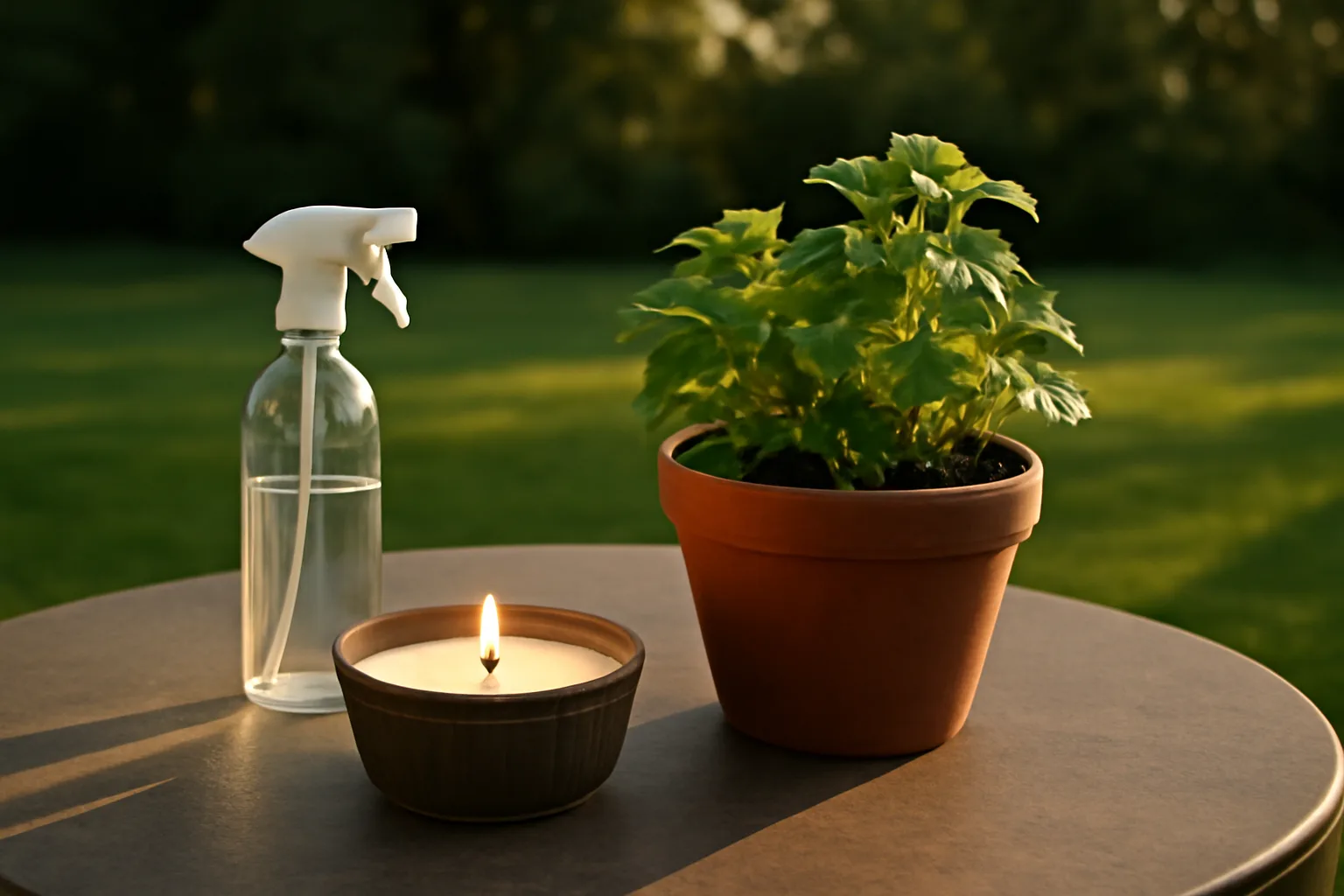
A mosquito repellent plant is any plant whose leaves or oils contain compounds that mosquitoes are shown to avoid when the oil is extracted and concentrated, not a plant that clears a yard just by growing in it. That distinction trips up a lot of people at the garden center. Citronella grass (Cymbopogon nardus), lemon eucalyptus, lavender, catnip, marigolds, and lemon balm all show some repellent activity when their essential oils are tested in a lab. Catnip oil in particular performed well against mosquitoes in early lab studies, in some cases outperforming DEET on a pure concentration basis in vitro. But there's a real gap between "the extracted oil repels mosquitoes in a lab dish" and "the plant growing in a pot on your porch keeps mosquitoes off you." Intact plants release those compounds slowly and in far lower concentrations than a crushed-leaf oil extract, so the practical effect of potted citronella or marigolds around a patio is modest at best. What plants actually help with is standing water, not repellency. Some ornamental grasses and dense groundcovers reduce the shady, moist microhabitats mosquitoes rest in during the day. That is a real but small piece of a yard-control plan, not a replacement for one. If you like the idea of a plant border anyway, put citronella, lemon balm, and marigolds near seating areas, not property edges, since that's where any faint effect can actually reach you.
How do I get rid of mosquitoes in my house or in a single room?
Indoor mosquito problems almost always trace back to one of three things: a door or window screen with a gap, a mosquito that rode in on clothing or a bag, or (less often) a small water source indoors like a clogged houseplant saucer or a forgotten vase. Start with the screens. Check every window and door screen for tears, and check that door sweeps actually seal at the bottom; a gap of a quarter inch is enough. Empty and dry any standing water indoors, plant saucers, vases, pet bowls left out for days. For a mosquito that's already inside, a few things work in the short term: a fan pointed across the room (mosquitoes are weak fliers and struggle against moving air), a plug-in repellent device using an EPA-registered active ingredient near where you sleep, and simply hunting it down when it lands, since indoor mosquitoes tend to rest on walls or under furniture during the day rather than fly constantly. Citronella candles and diffusers indoors are mostly a waste in an enclosed room; the smoke and scent build up before the repellent effect does much, and you're better off finding the entry point. If mosquitoes keep getting in day after day, that's a screen or door-sweep problem, not a repellent problem.
How do I keep mosquitoes away from my yard and patio?
Keeping mosquitoes away from a yard takes layering. No single product does it alone. The order of effectiveness, based on how mosquito life cycles work, runs roughly: eliminate breeding water first, then treat vegetation where adults rest, then add personal repellent for the times you're outside. Mosquitoes need standing water to breed, and it doesn't take much. The CDC notes that container-breeding species like Aedes aegypti can complete their life cycle in water that's been standing for as little as a week, in containers as small as a bottle cap [4]. Walk the yard after every rain and dump anything holding water: clogged gutters, saucers under pots, tarps, kiddie pools, tire swings, unused watering cans. After source reduction, adult mosquitoes still rest in shady, humid vegetation during the day, tall grass, dense shrubs, ivy. A barrier spray applied to that vegetation (not a fogger blasted into open air) is what knocks down the resting population, and that's the mechanism behind most professional yard treatments, including the 10 to 14 day cycle used in a lot of seasonal service plans, ours included. A licensed applicator can also confirm which registered products fit a yard with pets, a garden, or a pond. See our mosquito control page for how barrier treatments and misting systems differ in practice, and mosquito control near me if you're ready to compare local options. For the personal layer, EPA-registered repellents (DEET, picaridin, IR3535, OLE/PMD, or 2-undecanone) applied to skin or clothing are what CDC recommends for actual protection during peak biting hours [3]. None of this eliminates a mosquito population; it knocks it down and keeps it down as long as you keep at it.
How long do natural repellents like citronella actually last on skin?
Not long, and that's the main practical limitation. In the 2002 New England Journal of Medicine field study, a soybean-oil-based repellent gave about 94 minutes of protection, a citronella-based product gave about 20 minutes, and products marketed as containing herbal oils clustered even lower, some under 20 minutes [2]. Compare that to roughly 301 minutes for a 23.8% DEET product tested in the same study. Oil of lemon eucalyptus is the outlier among natural-derived options because the active compound (PMD) is concentrated and standardized in EPA-registered formulations, giving it a real, reapplication-worthy window of protection, about 2 hours per the CDC's repellent guidance [3]. Straight lemon eucalyptus essential oil, sold as an aromatherapy product rather than a registered repellent, is a different thing entirely and isn't tested or labeled for repellent efficacy. Practically, that means citronella-based sprays and candles need reapplication or replacement every 20 to 30 minutes to keep any effect going, which is why they work fine for a short time on the porch and fail for a full evening outside.
How do I get rid of ticks in my yard?
Tick control in a yard relies on the same principle as mosquito control: change the habitat before you reach for a spray. Ticks don't fly or jump; they climb onto grass and low shrubs at yard edges and wait for a host to brush past, a behavior called questing. Extension and public health guidance recommends a few specific yard changes: keep grass mowed short, clear leaf litter and brush, and create a barrier of wood chips or gravel at least 3 feet wide between lawn and wooded areas or stone walls, since ticks rarely cross a dry, open strip like that [5]. Stack woodpiles neatly and in dry, sunny spots, since damp woodpiles draw in the rodents that carry ticks in early life stages. For active treatment, licensed applicators use barrier sprays targeted at the yard edge, the mulch and leaf-litter zones, and stone walls, which is where the CDC notes most tick exposure in a yard actually happens, not the open lawn [6]. A single spring or fall application isn't enough in most climates; ticks are active any time temperatures stay above about 45°F, according to tick ecology research cited by state health departments, which in a lot of regions means March through November. If you want a repellent to carry on your skin or clothing between yard treatments, our tick repellent guide covers what's registered and what isn't. Don't get ticks and mosquitoes as "either/or" purchases. Because both are managed with vegetation-focused barrier applications, most yard services (Duskproof included) treat for both mosquitoes and ticks in the same visit, since the target zones overlap heavily.
How do you get rid of ticks specifically brought in by pets or wildlife?
A yard treatment plan reduces ticks in the environment, but it can't stop new ticks from arriving on a dog, a deer, or a rodent passing through. That's a separate, ongoing piece. Talk to a veterinarian about a tick preventive product for any dog or cat that goes outside; this is a medical decision based on the animal's health history, not something to improvise from a yard-care article. Check pets after they've been in tall grass or wooded edges, focusing on ears, between toes, and the collar line, since ticks often take hours to find a spot to attach. Fencing that excludes deer, where practical, measurably reduces tick populations in a yard over a season or two, since deer are a major host for adult blacklegged ticks in much of the eastern U.S. It's a bigger project than a spray, but for yards backing onto woods it's one of the few interventions with real population-level effect.
When do mosquitoes go away for the season?
Mosquito activity drops off once nightly temperatures fall consistently below about 50°F, since most mosquito species become inactive and stop biting in that range, though the exact number varies by species and region. There's no fixed calendar date; it depends entirely on local weather. In much of the northern U.S., that means mosquito season effectively winds down in October, sometimes lingering into November in a mild fall. In the Gulf Coast, Florida, and parts of the Southwest, mosquitoes can stay active nearly year-round during warm winters, which is exactly why extension services in those states frame mosquito control as a twelve-month issue rather than a seasonal one. Cold doesn't kill mosquitoes outright, either. Many species overwinter as eggs (able to survive freezing) or as adult females tucked into sheltered spots, ready to resume biting once temperatures climb again in spring. Because the true end date is local, the most reliable answer is to check your state or county extension service or health department's mosquito surveillance page for that year's activity, since they track actual trap counts, more than the calendar. If you're timing when to start or stop a barrier treatment plan, our mosquito overview covers the biology behind seasonal activity in more depth.
What's the difference between a repellent and a barrier treatment?
A repellent is something you put on your skin or clothing to make yourself less appealing to bite, temporarily and only in the area covered. A barrier treatment is applied to yard vegetation, mostly the undersides of leaves where adult mosquitoes rest during the day, and it reduces the resting population in that space for a period of time, typically framed on a 10 to 14 day retreatment cycle in professional service plans. They solve different problems and most homeowners eventually want both. Repellent covers you personally when you step outside the treated zone (hiking, a friend's untreated yard, camping). Barrier treatment covers the space itself so you're not reapplying repellent every time you want to sit on the patio. Misting systems are a third option: a plumbed system that releases a fine mist of an EPA-registered product on a timer or remote trigger, giving more frequent, lower-dose coverage than a barrier spray visit every couple of weeks. They cost more upfront (installation plus ongoing product) but suit yards with heavy, daily outdoor use, big decks, pools, outdoor kitchens. Neither barrier sprays nor misting systems eliminate a mosquito population; both knock it down and need to be maintained on a schedule to keep it down, which is the honest expectation any legitimate provider should set before you sign up. A free yard walk-through is the fastest way to find out which fits a specific property; that's what our free yard assessment covers, no cost and no obligation either way.
How do the different repellent options actually compare?
| Option | Active ingredient | Approx. protection time | Best use | |
|---|---|---|---|---|
| DEET 23.8% | DEET | ~301 minutes [2] | Long outdoor exposure, hiking, camping | |
| Oil of lemon eucalyptus (PMD) | PMD | ~120 minutes [3] | Skin protection for those avoiding DEET | |
| Picaridin 20% | Picaridin | Comparable to DEET at similar concentration [3] | Alternative to DEET, less odor | |
| Soybean oil-based | Soybean oil | ~94 minutes [2] | Short exposure, mild activity | |
| Citronella-based spray | Citronella oil | ~20 minutes [2] | Brief outdoor sitting, needs frequent reapplication | |
| Citronella candle | Citronella oil (vapor) | Reduces landing rate modestly at close range; effect drops sharply beyond a few feet | Ambient patio use, not primary protection | |
| Yard barrier treatment | Varies (EPA-registered, applied to vegetation) | ~10-14 days per application cycle (professional service standard) | Whole-yard population reduction | The numbers in the top rows come from one controlled 2002 field study [2]; other studies since have found similar ranking even when exact minutes shift a bit with formulation and mosquito species. The takeaway that's held up across the research: concentration and registered active ingredient matter far more than whether a product is labeled "natural." |
What should I actually do this week to cut mosquitoes and ticks around my house?
Start outside, not with a spray bottle. Walk the property after the next rain and dump every container holding water, then check gutters, since a clogged gutter is one of the most common overlooked mosquito sources found by mosquito control districts. Mow tall grass, clear leaf litter near fences and stone walls, and if the yard backs onto woods, add a mulch or gravel strip at the tree line to cut down on tick questing habitat. Keep pet tick preventives current if you have dogs or outdoor cats. For personal protection during peak hours (usually dawn and dusk for most mosquito species), use an EPA-registered repellent (DEET, picaridin, IR3535, or OLE/PMD) rather than relying on candles or wristbands for anything beyond very short exposure. Treat citronella and plant-based options as a nice-to-have on the patio table, not the plan. If the yard has a real, repeat problem, standing water you can't fully eliminate, heavy shade, a wooded edge, that's when a professional barrier treatment on a 10 to 14 day cycle or an installed misting system starts to make sense over do-it-yourself sprays alone. A free yard assessment can tell you honestly whether that's overkill for your situation or exactly what's needed; you can get a free yard assessment to find out.
Frequently asked questions
How do I get rid of mosquitoes for good?
You can't eliminate mosquitoes completely; the realistic goal is knocking the population down and keeping it down. That means removing standing water weekly, treating resting vegetation with a barrier spray on a repeat cycle (commonly 10 to 14 days), and using an EPA-registered personal repellent when you're outside during peak biting hours.
How do I keep mosquitoes away without chemicals?
Source reduction is your strongest chemical-free tool: dump standing water weekly, fix window screens, and add a fan on the patio since mosquitoes fly poorly in moving air. Citronella candles and repellent plants (lemon balm, marigolds, citronella grass) help a little at close range but won't cover a whole yard on their own.
What plants repel mosquitoes the best?
Citronella grass, lemon eucalyptus, catnip, lavender, and lemon balm all contain compounds shown to repel mosquitoes when extracted as oils. Growing the plant alone releases far less of that compound than a concentrated oil, so treat them as a mild bonus near seating areas, not a stand-in for repellent or yard treatment.
How do I get rid of mosquitoes in my house?
Check every window and door screen for gaps and make sure door sweeps seal fully. Empty standing water in plant saucers or vases, run a fan in the room, and use an EPA-registered plug-in or spray repellent if one is already inside. Repeated indoor mosquitoes almost always mean a screen or entry-point problem, not a repellent problem.
When do mosquitoes go away for the year?
Most species slow down once nighttime temperatures fall consistently below about 50°F, which often means October or November in northern climates. In warm-winter regions like Florida or the Gulf Coast, mosquitoes can stay active nearly year-round. Check your state or county extension or health department's mosquito surveillance page for local timing.
How do you get rid of ticks in your yard?
Mow grass short, clear leaf litter, and build a 3-foot-wide mulch or gravel barrier between lawn and wooded edges, since ticks rarely cross open, dry strips (extension service recommendation). Barrier sprays applied to yard edges and stone walls, where ticks actually quest, add further reduction but need repeat applications through the active season.
Does citronella actually work against mosquitoes?
It works, but weakly and briefly. A 2002 New England Journal of Medicine study found a citronella-based repellent gave about 20 minutes of protection compared to roughly 301 minutes for a 23.8% DEET product. Citronella candles reduce landing rates modestly within a few feet but the effect fades fast with distance and time.
Is oil of lemon eucalyptus a good natural repellent?
Yes, it's the standout among plant-derived repellents. The CDC and EPA list oil of lemon eucalyptus (as PMD) as a registered repellent giving roughly 2 hours of protection, comparable to low-concentration DEET. Note this refers to the registered PMD formulation, not raw lemon eucalyptus essential oil sold for aromatherapy.
How often should I reapply natural mosquito repellent?
Citronella-based sprays typically need reapplication every 20 to 30 minutes based on field study results. Oil of lemon eucalyptus (PMD) products, being EPA-registered and standardized, hold up longer, generally around 2 hours, closer to how synthetic repellents perform.
What kills mosquitoes in the backyard without hurting pets?
No spray is automatically pet-safe just because it's labeled natural; safety depends on the specific product, concentration, and label instructions. A licensed applicator can recommend an EPA-registered product and application method suited to yards with pets, and most barrier treatments are applied to vegetation, not open lawn where pets roam.
Do mosquito repellent bracelets and wristbands work?
They give very limited, localized protection at best, since the repellent only affects the small area right around the wrist rather than your whole body. They're not evaluated the same way as EPA-registered skin repellents in field studies and shouldn't be relied on for real outdoor protection.
How is a mosquito barrier treatment different from a misting system?
A barrier treatment is a visit-based spray, often on a 10 to 14 day cycle, applied to yard vegetation where adult mosquitoes rest. A misting system is an installed, plumbed setup that releases treatment automatically on a timer, giving more frequent coverage for yards with heavy daily outdoor use, at a higher upfront cost.
Can I get rid of ticks and mosquitoes with the same treatment?
Often yes, since both pests are managed by treating the same yard-edge vegetation, leaf litter, and shaded areas rather than open lawn. Many professional seasonal plans, including barrier treatment services, address both pests in a single visit because their habitats overlap heavily.
Sources
- EPA, Repellent active ingredients registered for skin application: EPA lists DEET, picaridin, IR3535, oil of lemon eucalyptus (PMD), and 2-undecanone as registered skin repellent active ingredients
- New England Journal of Medicine, Fradin & Day, 'Comparative Efficacy of Insect Repellents against Mosquito Bites' (2002): Field study comparing protection times of DEET, oil of lemon eucalyptus, soybean oil, and citronella-based repellents
- CDC, Preventing Mosquito Bites: CDC recommends EPA-registered repellents including DEET, picaridin, IR3535, and oil of lemon eucalyptus (PMD)
- CDC, Mosquito Life Cycle: Container-breeding mosquitoes like Aedes aegypti can complete their life cycle in standing water within about a week
- CDC, Preventing Tick Bites: Landscaping and Yard Work: A barrier of wood chips or gravel between lawns and wooded areas reduces tick migration into yards
- CDC, Preventing Tick Bites on People: CDC guidance on where ticks are commonly encountered in yards, including leaf litter and edge habitats